


By Paul Lucky Okoku
A reflection on leadership transition, experience, and the delicate balance between urgency and stability as Ghana prepares for the world stage.
In football, a new coach does not just bring ideas, he inherits expectations, timing, and the weight of a nation.
A late appointment can steady a team—or unsettle its rhythm. The difference is rarely in experience, but in timing. In moments of uncertainty, experience offers guidance, but timing determines its impact.
There comes a moment in every football journey when change is no longer a possibility, it becomes a reality.
And when that change arrives close to a major tournament, it carries a different kind of weight.
I have seen it before.
A team preparing for competition is not just building fitness, it is building familiarity. A rhythm. A shared understanding.
Introduce a new voice too late, and the challenge is not knowledge.
It is time.
A New Chapter for Ghana
The Ghana Football Association has now turned the page.
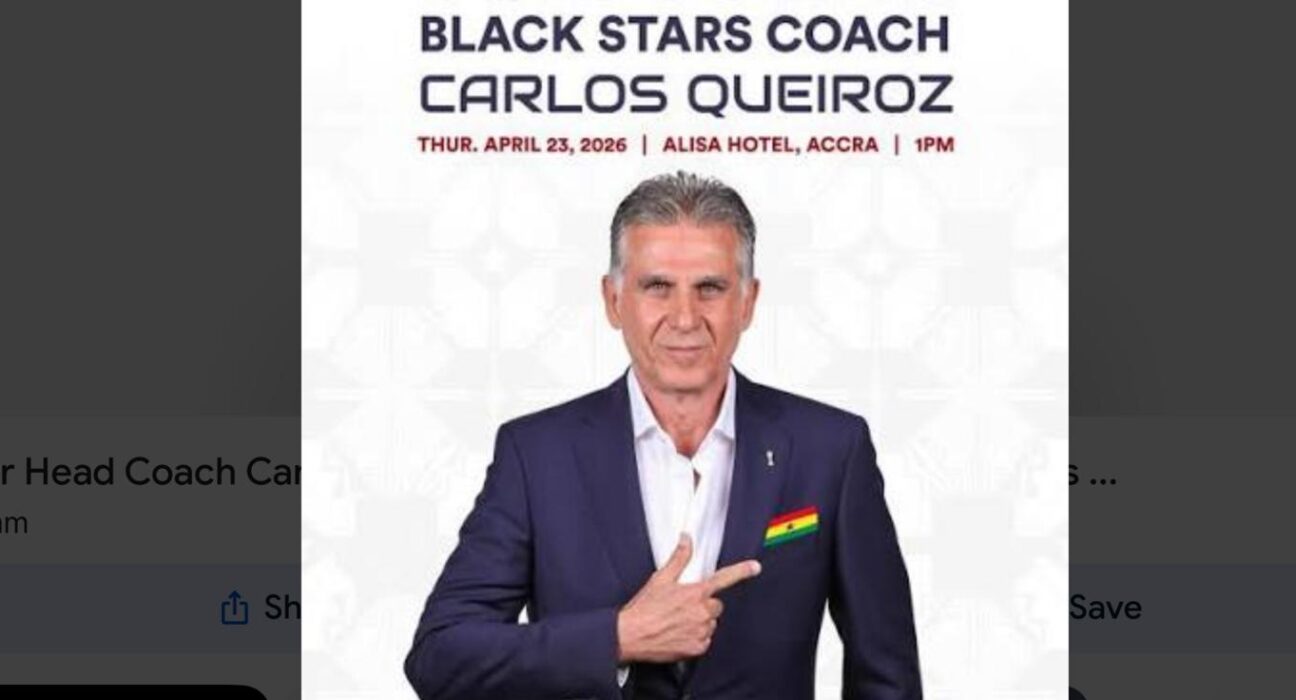
With the appointment of *Carlos Queiroz* as head coach of the Black Stars, Ghana signals a clear intention—to rely on experience as it approaches the 2026 FIFA World Cup.
At 73, Queiroz brings with him one of the most extensive managerial résumés in international football.
This is not an experimental appointment…
It is a deliberate one.
Experience at the Highest Level
Carlos Queiroz is no stranger to the global stage. His career spans decades, including roles both as a head coach and at the highest levels of club football. Notably:
- Former assistant at Manchester United
- Former assistant at Real Madrid
- Head coach of the Portugal national football team
- Long-serving manager of the Iran national football team
- Managed the Colombia national football team and Egypt national football team
Across these roles, he has led teams to multiple FIFA World Cups, often building sides known for defensive organization, discipline, and structure. However, tournament experience, while valuable, does not eliminate the realities of late transition.
The Challenge of Timing
This appointment comes under unique circumstances.
A coach stepping in just months before the World Cup is not building from the ground up, he is adapting, adjusting, and attempting to refine within a compressed window.
There is limited time for:
- Tactical implementation
- Player adaptation
- Physical synchronization
And this raises a natural question, not of doubt, but of reality:
Will there be enough time to fully align the team?
Because at the World Cup level, margins are defined not just by talent, but by cohesion.
The Opening Test: Ghana’s First Step on the World Stage
Ghana’s World Cup journey begins on June 17, 2026, against Panama in Toronto, Canada.
The opening match in any World Cup carries a unique significance. It is not just about points it is about tone, confidence, and psychological momentum. For a team adjusting to new leadership under Carlos Queiroz, this first encounter becomes even more critical.
A positive result can stabilize belief. A difficult start can increase pressure.
And in a tournament of fine margins, the opening step often shapes the path that follows.
The Road Ahead: Group L and the Test of Balance
Ghana’s Group L schedule presents a balanced yet demanding pathway:
Ghana vs Panama — June 17, 2026 (Toronto, Canada)
England vs Ghana — June 23, 2026 (Boston, USA)
Croatia vs Ghana — June 27, 2026 (Philadelphia, USA)
Each fixture brings its own challenge, but also its own opportunity.
At the World Cup level, every team deserves to be viewed with equal respect—without diminishing the strength or potential of any side.
There are no more minnows in world football, underestimate any team at your own peril, and often to your detriment.
At this stage, qualification itself changes the equation. Once you arrive on the World Cup stage, perceived rankings begin to lose their weight, and performance becomes the only true currency.
Every team in the group has earned its place.
And with that comes a simple truth:
There is no easy game—but there is always a chance. Football is like cookies—you never quite know where it will break.
This is why the World Cup remains the most unpredictable stage in football, where preparation meets possibility, and outcomes are never fully written in advance.
A Hope, Not a Prediction
I sincerely hope this decision works for Ghana.
Because we have seen situations like this before in football, where late changes can either sharpen a team… or disrupt its internal rhythm.
Sometimes, it stabilizes.
Other times, it backfires.
That is not criticism—it is history.
And history reminds us that football does not always reward urgency.
Leadership and Responsibility
What must also be acknowledged is this:
Decisions at this level are never casual.
The leadership of the *Ghana Football Association* would have weighed multiple factors—performance, perception, preparation, and national expectation. Whether agreed with or not, the decision has been made. And once made, it carries responsibility.
But it also deserves respect.
Because ultimately, every decision at that level is taken with one objective: To serve the nation.
Key Questions Moving Forward
As Ghana enters this new phase under Carlos Queiroz, several important questions naturally arise:
- Which matches will he oversee before the World Cup to establish tactical identity?
- Were there other candidates considered for this role?
- What were the full internal considerations behind the transition from Otto Addo?
These are not questions of doubt, but of understanding.
The success of this appointment will not be defined by experience alone, but by how quickly experience can translate into cohesion.
Final Reflection
Football has always been a game of fine margins.
And in moments like this, timing becomes everything.
Ghana has chosen experience.
Now, the journey ahead will determine whether that experience arrives at the right time.
This analysis is presented to document facts, historical patterns, and governance issues in global football and sport governance. It is not intended to apportion blame, but to provide context, continuity, and evidence that can inform public discourse, policy evaluation, and institutional reform.
Very respectfully, in football—as in life—the right decision made at the wrong time can still carry consequences.
Share Note
If this article added value or offered perspective, you’re welcome to share it with others.
Paul Lucky Okoku
Former Nigerian International Footballer | Football Analyst
Published Online
Former Nigerian Super Eagles International
• CAF Africa Cup of Nations (AFCON) 1984 — Silver Medalist
• WAFU Nations Cup 1983* — Gold Medalist
• CAF Tesema Cup (U-21) 1983* — Gold Medalist
• FIFA U-21 World Cup, Mexico 1983 — Vice-Captain, Flying Eagles of Nigeria (Class of 1983)