

By Paul Lucky Okoku
A halted match in Lisbon exposes a deeper truth — racism remains football’s most persistent opponent
Football may unite nations, but racism still divides the humanity within the game.
When a player is racially abused, the match does not stop because of football — it stops because humanity has failed.
The greatest threat to the global game is not poor officiating, bad governance, or declining talent — it is the continued tolerance of racial hatred.
The Incident That Stopped a Match — But Should Stop the World
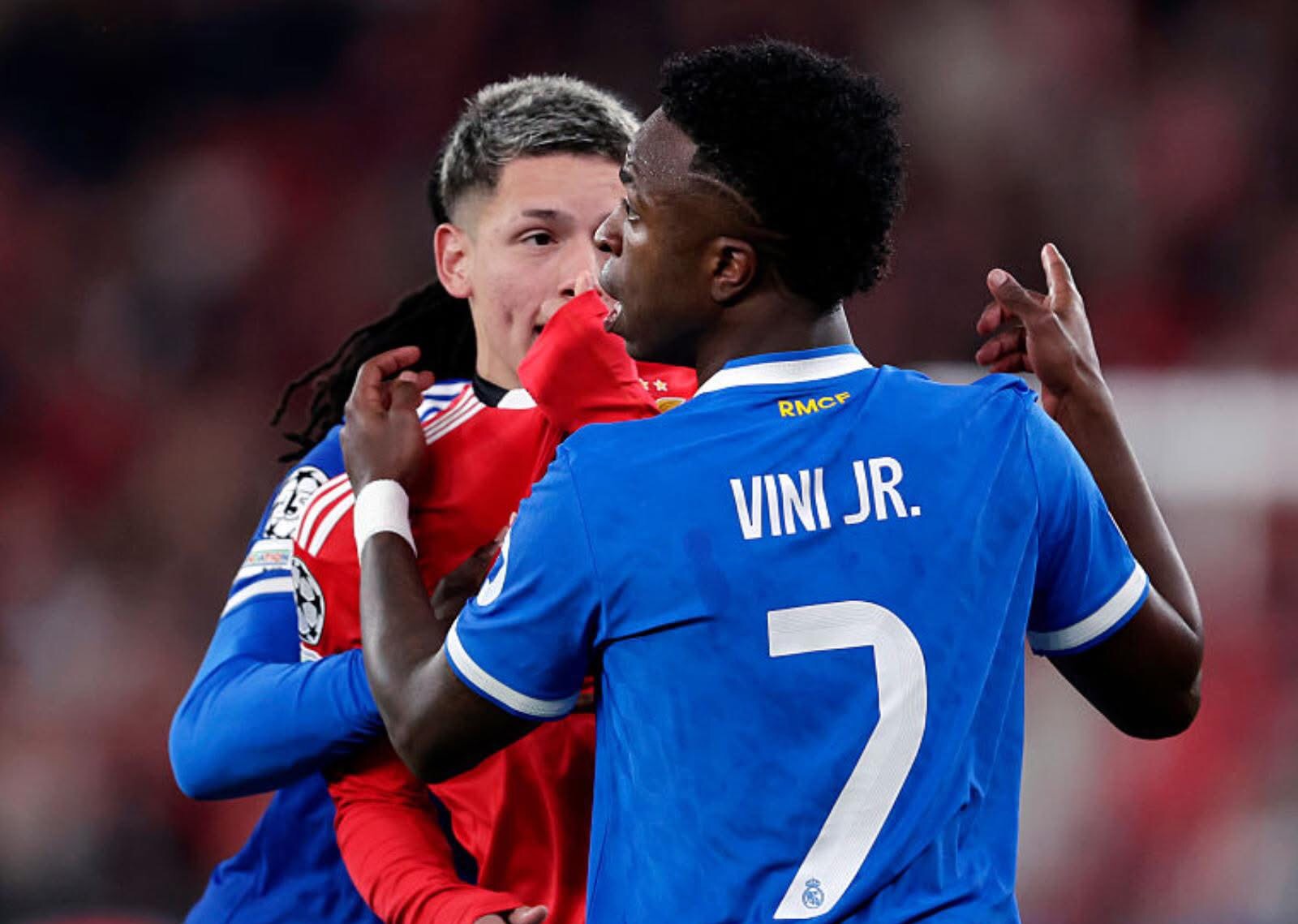
During a high-profile UEFA Champions League match between Real Madrid and Benfica in Lisbon, Portugal, on February 17, 2026, play was halted for several minutes after Brazilian star Vinícius Júnior reported being racially insulted.
According to multiple match reports, the allegation was directed at Benfica winger Gianluca Prestianni, an Argentine international youth player. The incident immediately drew global attention, not only because of the seriousness of racial abuse in football, but also because it touched on broader cultural and historical sensitivities within the global game. As of the time of reporting, the matter remained an allegation subject to investigation by football authorities.
When Historic Rivalries Spill Beyond Competition
Football rivalries should elevate the game — never diminish human dignity.
The emotional intensity between football cultures such as Brazil and Argentina is among the most celebrated rivalries in world sport.
For generations, the two nations have competed for continental dominance, producing legendary matches and shaping global football identity.
However, this rivalry has occasionally carried undertones that extend beyond athletic competition.
In moments of high tension, such historical animosity can risk spilling into personal exchanges on the field.
If the allegation of racial language were to be confirmed, it would represent a deeply unfortunate escalation — transforming a sporting rivalry into a matter of human dignity.
Such incidents remind the football world that while competition fuels passion, it must never cross into prejudice.
It is important to note that allegations of racial abuse must always be treated with seriousness, fairness, and due process. Determining intent, context, and responsibility rests with official football authorities through proper investigation.
Regardless of the final findings, the incident once again highlights the fragile boundary between passionate rivalry and unacceptable discrimination — a boundary that global football must protect with unwavering clarity.
For many observers, it was another unfortunate episode.
For Black players across the world, it was something far deeper.
It was a painful reminder that despite decades of progress, enormous wealth in the sport, and global anti-racism campaigns, football — the world’s most universal game — still struggles to protect the dignity of its Black athletes.
The stoppage of play was not merely procedural.
It was symbolic.
It represented a moment when the sport was forced to confront its own conscience.
*Due Process, Context, and the Responsibility of Fair Judgment*
“Justice in football must protect both dignity and truth.”
Following the incident, UEFA opened an official investigation into the alleged exchange between the players.
According to multiple media reports, including those citing sources familiar with the inquiry, Benfica winger Gianluca Prestianni of Argentina has provided his account to investigators. Reports indicate that he denied racial intent and stated that the language allegedly used was not racially motivated, a matter that now remains under official review.
As of this writing, UEFA has not issued a final ruling, and the investigation remains ongoing.
It is therefore essential that conclusions be guided by evidence, impartiality, and due process rather than public speculation.
However, regardless of the ultimate findings, the incident has once again exposed a broader reality: racial tensions in football remain deeply sensitive, and even allegations alone reflect the fragile environment in which Black players continue to compete.
The Danger of Blind Defensiveness in Allegations of Racism
Justice requires patience — but humanity requires sensitivity.
Another troubling dimension of this incident has been the immediate and forceful public defense mounted by some observers, officials, and supporters who were not present during the alleged exchange.
In moments involving accusations of racial abuse, the rush to take sides without firsthand knowledge can deepen divisions and inflict further emotional harm on those involved.
It is entirely appropriate to emphasize due process.
It is entirely reasonable to caution against premature judgment.
However, there is an important distinction between advocating fairness and issuing categorical denials without direct evidence.
Reports from the match indicated that the accused player appeared to cover his mouth while speaking during the confrontation — a gesture that, regardless of its intent, naturally raised questions and intensified scrutiny among viewers and analysts.
Such actions do not establish guilt, but they do underscore why measured responses are essential until official investigations are completed.
Why Blind Defense Can Be Harmful
When public figures — including coaches, teammates, and supporters — quickly dismiss allegations without acknowledging their seriousness, it can create the perception of insensitivity toward the broader issue of racism in sport.
For players who believe they have been subjected to abuse, such reactions may compound the emotional impact.
The issue then shifts from being solely about what was said to whether the victim’s concerns are being treated with empathy and respect.
Responsible leadership in such situations requires a careful balance:
• Supporting one’s own player
• Respecting investigative processes
• Recognizing the historical context of racial abuse in football
Failure to maintain this balance risks reinforcing distrust and deepening existing tensions within the global football community.
The Principle of Responsible Public Response
In highly sensitive cases, the most constructive approach is neither immediate condemnation nor unconditional defense.
Rather, it is a commitment to neutrality, patience, and acknowledgment of the seriousness of the issue.
Statements such as:
• “We were not present and cannot confirm what occurred”
• “We support a thorough investigation”
• “Racism in any form is unacceptable”
demonstrate professionalism while preserving fairness.
Such responses help protect both the integrity of the investigation and the dignity of all parties involved.
Racism in Football: A Persistent Global Pattern
The incident involving Vinícius Jr. did not occur in isolation.
It fits into a troubling historical pattern that stretches across continents, leagues, and generations.
From monkey chants in European stadiums to online abuse targeting African players, racism in football has remained one of the sport’s most enduring and unresolved crises.
Despite strict regulations from FIFA, UEFA, and national associations, enforcement has often been inconsistent.
Punishments frequently fall short of deterrence.
Clubs are fined modest amounts.
Matches continue.
And players are left to carry emotional scars long after the final whistle.
Why Vinícius Jr.’s Case Resonates Globally
Vinícius Jr. is not merely another player.
He represents a new generation of Black athletes who have grown up in an era that promises equality, yet continue to face old prejudices.
His experience resonates deeply because it highlights a painful contradiction:
Football celebrates Black talent while simultaneously failing to fully protect Black humanity.
The same player who fills stadiums, generates millions in revenue, and inspires young fans can still be subjected to racial abuse without immediate systemic accountability.
This contradiction lies at the heart of football’s moral dilemma.
The Psychological Toll on Players
Racial abuse in football is often discussed in terms of disciplinary action, but its psychological impact is rarely examined with sufficient seriousness.
For players, such incidents can trigger:
• Emotional trauma
• Loss of concentration during matches
• Erosion of confidence
• Long-term mental health consequences
Athletes are expected to perform at elite levels while simultaneously absorbing insults that attack their identity, heritage, and dignity.
This burden is neither fair nor sustainable.
Why Anti-Racism Campaigns Have Fallen Short
Football authorities have launched numerous campaigns against racism.
Slogans appear on banners.
Players kneel before matches.
Messages are displayed on television broadcasts.
Yet, the persistence of incidents like this reveals a fundamental truth:
Symbolism alone cannot defeat systemic prejudice.
The failure lies in three major areas:
1. Inconsistent enforcement of rules
2. Insufficient deterrent punishments
3. Lack of accountability at institutional levels
Without structural change, campaigns risk becoming performative rather than transformative.
A Global Issue Beyond Europe
Although many high-profile incidents occur in European football, racism in sport is not confined to one region.
It reflects broader societal inequalities.
From grassroots leagues to professional competitions, Black athletes worldwide face similar challenges:
• Discriminatory treatment by officials
• Unequal opportunities in coaching and leadership roles
• Underrepresentation in decision-making bodies
This makes the fight against racism in football not just a sporting issue, but a global human rights concern.
* The Responsibility of Football Institutions
Football governing bodies must move beyond statements and embrace meaningful action.
This includes:
• Automatic match suspensions when racism is reported
• Severe sanctions for clubs failing to control fans
• Lifetime bans for repeat offenders
• Mandatory anti-racism education programs
Accountability must be systemic, not symbolic.
Only then can the sport demonstrate true commitment to equality.
Yet beyond the responsibility of global institutions lies a more uncomfortable and far-reaching reality. The persistence of racial abuse in football is not sustained only by those who perpetrate it, but also by the silence and continued financial support of millions who consume the game without demanding stronger accountability.
Nowhere is this contradiction more evident than in Africa, where passionate support for European leagues continues to grow even as Black players repeatedly face discrimination on the very stages that African audiences help sustain economically.
Lessons for African and Global Football Leadership
For African football stakeholders and administrators, incidents like this serve as an important reminder.
The fight against racism must begin internally.
African football systems must ensure:
• Fair treatment of players within domestic leagues
• Merit-based selection processes
• Protection from discrimination of all forms
By strengthening governance at home, African football can contribute meaningfully to global reform efforts.
The Role of Players as Agents of Change
Modern players possess unprecedented influence through social media and global visibility.
Their voices matter.
Their refusal to tolerate abuse sends powerful messages.
Vinícius Jr.’s decision to speak out reflects a growing shift in athlete activism.
Today’s players are no longer willing to remain silent.
They understand that silence enables injustice.
*The Broader Human Message*
At its core, this incident is not only about football.
It is about dignity.
It is about the universal right of every individual to work, compete, and live free from racial discrimination.
When racism occurs in a stadium watched by millions, it exposes deeper societal failures.
And when matches are halted because of hate, it reminds the world that sport cannot truly unite humanity until equality is achieved.
Editorial Note:
This analysis is presented to document facts, historical patterns, and governance issues in global football. It is not intended to apportion blame, but to provide context, continuity, and evidence that can inform public discourse, policy evaluation, and institutional reform.
Closing Reflection
The stoppage of play during the Real Madrid vs. Benfica match should not be remembered merely as a disruption.
It should be remembered as a moment when football was forced to confront its unfinished moral journey.
The game has evolved tactically, commercially, and technologically.
But until racism is eliminated, its ethical evolution remains incomplete.
Football’s greatest victory will not be measured by trophies, revenues, or viewership.
It will be measured by the day when every player, regardless of race, can compete without fear, prejudice, or humiliation.
Football is not only about goals and glory — it is about safeguarding the humanity of those who play the game.
If this article added value or offered perspective, you’re welcome to share it with others.
Paul Lucky Okoku
Former Nigerian International Footballer | Football Analyst
Published Online
Former Nigerian Super Eagles International
• CAF Africa Cup of Nations (AFCON) 1984 — Silver Medalist
• WAFU Nations Cup 1983* — Gold Medalist
• CAF Tesema Cup (U-21) 1983* — Gold Medalist
• FIFA U-21 World Cup, Mexico 🇲🇽 1983 — Vice-Captain, Flying Eagles of Nigeria 🇳🇬 (Class of 1983)
Leave feedback about this