


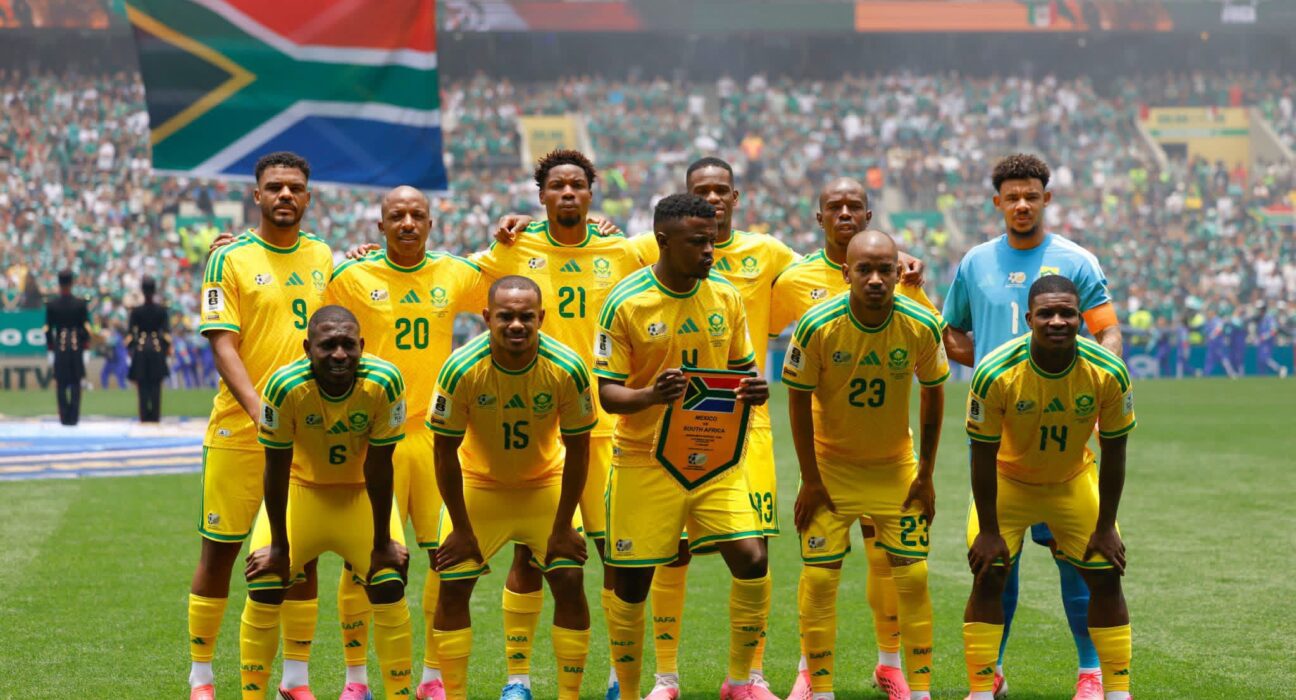
Atlas Lions Continue Their Global Rise While Bafana Bafana Reach Knockout Stages for the First Time Ever
African football celebrated another landmark moment at the 2026 FIFA World Cup as Morocco and South Africa both secured places in the Round of 32, continuing the continent’s growing influence on football’s biggest stage.
Morocco became the first African nation to officially qualify for the knockout rounds after a dramatic 4-2 comeback victory over Haiti, while South Africa followed shortly afterward by defeating South Korea 1-0 to reach the World Cup knockout stages for the first time in the country’s history.
Together, the results represent another significant chapter for African football, four years after Morocco’s historic run to the semi-finals in Qatar transformed perceptions of what African nations could achieve at the World Cup.
Morocco’s qualification marks only the third time the Atlas Lions have advanced beyond the World Cup group stage, following previous achievements in 1986 and 2022.
However, their path to the Round of 32 was far from straightforward.
Already eliminated but determined to make a statement, Haiti twice took the lead against one of Africa’s strongest teams. An early own goal involving goalkeeper Yassine Bounou stunned the Moroccans before Wilson Isidor restored Haiti’s advantage after Morocco had equalized.
The Atlas Lions responded with the resilience that has become their trademark.
Captain Achraf Hakimi delivered one of the finest performances of his international career, scoring his first-ever World Cup goal and later providing an assist. In doing so, he became only the second Moroccan player to both score and assist in a World Cup match, following Abdeljalil Hadda’s achievement against Scotland in 1998.
Hakimi also became only the second Moroccan captain to score at a World Cup, following Romain Saïss in 2022.
The other star of the night was Ismael Saibari.
The PSV Eindhoven midfielder continued his extraordinary tournament by scoring for a third consecutive group-stage match, drawing level with Youssef En-Nesyri as Morocco’s joint all-time leading World Cup scorer with three goals.
Saibari’s strike also secured two remarkable continental records: First African player ever to score in all three group-stage matches of a single World Cup. First African player in history to score in each of his first three World Cup appearances.
With the match tied at 2-2 entering the final stages, Morocco’s depth proved decisive.
Substitute Soufiane Rahimi put the Atlas Lions ahead before young forward Gessime Yassine sealed the victory late on, completing a memorable comeback and sending Morocco into the knockout rounds unbeaten.
SOUTH AFRICA BREAK NEW GROUND
If Morocco’s qualification confirmed their status as one of Africa’s football powerhouses, South Africa’s achievement represented a historic breakthrough.
Bafana Bafana defeated South Korea 1-0 to secure qualification for the World Cup knockout stages for the first time ever, surpassing their previous best performances in 1998 and 2010 when they exited during the group phase.
The decisive moment arrived in the 63rd minute.
Thapelo Maseko, one of South Africa’s brightest young talents, produced the goal that changed the country’s football history.
At just 22 years and seven months old, Maseko became the second-youngest South African goalscorer in World Cup history, trailing only Benni McCarthy, who scored at France 1998 aged 20 years and seven months.
His goal carried even greater significance beyond South Africa.
Maseko, who plays for AEL Limassol, became the first player representing a Cypriot league club to score a goal at a FIFA World Cup.
The strike capped another disciplined performance from Hugo Broos’ side, whose defensive organization and tactical discipline have become defining characteristics of their remarkable rise.
South Korea enjoyed significant spells of possession but struggled to break down a resilient South African team that defended with composure and seized its opportunity when it arrived.
When the final whistle sounded, celebrations erupted among players and supporters who understood the magnitude of the achievement.
A NEW ERA FOR AFRICAN FOOTBALL
The simultaneous success of Morocco and South Africa highlights the continued evolution of African football on the world stage.
Morocco are building on the foundations of their historic 2022 semi-final run, proving that their success in Qatar was no one-off.
South Africa, meanwhile, have announced themselves as one of the tournament’s breakthrough stories, reaching the knockout rounds for the first time under the guidance of Hugo Broos.
One nation continues to rewrite expectations.
Another has shattered a historic barrier.
Together, they have ensured Africa will once again have a strong presence in the knockout rounds of the FIFA World Cup.
The Atlas Lions are carrying the momentum of a golden generation.
Bafana Bafana are living their greatest World Cup moment.
And for African football, the journey is only just beginning.