


By Kazeem Ajibola Shoyebo
The most obvious story surrounding the UEFA Super Cup in Salzburg is Omar Artan. The Somali referee will become the first non-European referee to take charge of the UEFA Super Cup, a historic appointment made only weeks after he was selected for the 2026 FIFA World Cup but prevented from participating after being denied entry to the United States. But the more consequential story may be standing beside him.
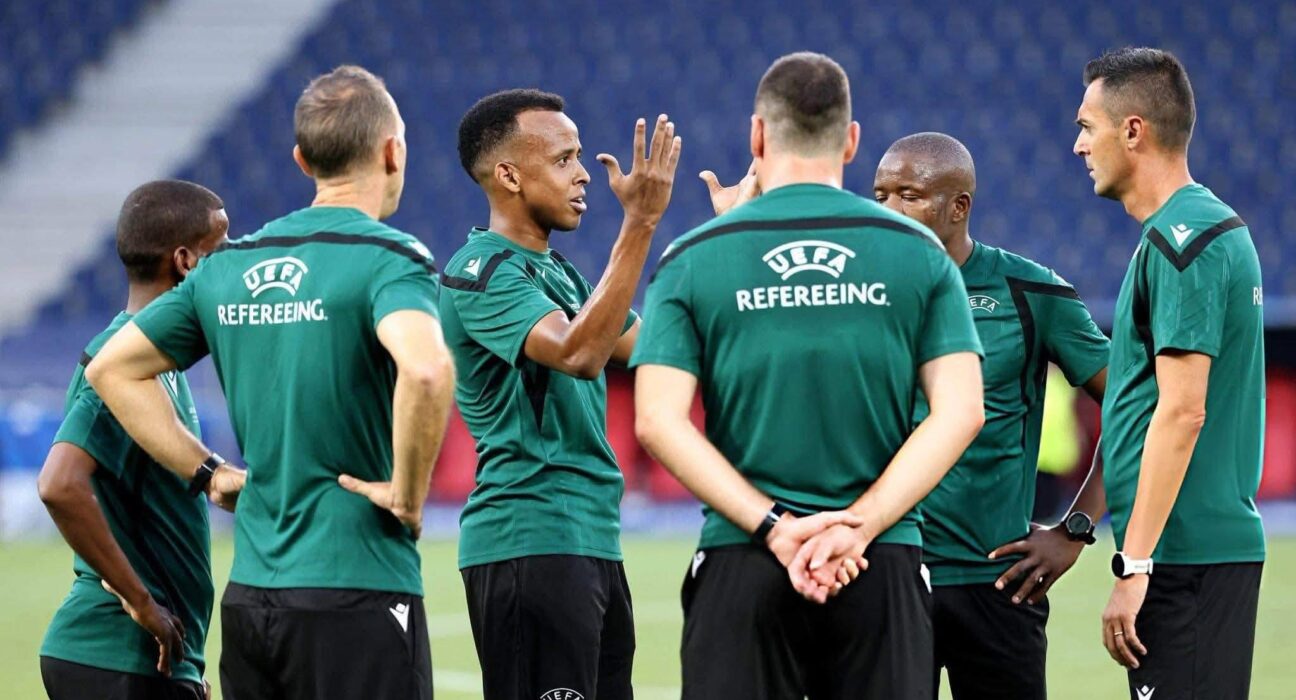
UEFA’s official match information confirms that Artan’s assistants for the Paris Saint-Germain-Aston Villa Super Cup are Liban Abdoulrazack Ahmed of Djibouti and Stephen Eleazar Onyango Yiembe of Kenya. The appointment therefore creates an all-East African officiating team: Somalia, Djibouti and Kenya.
That matters because this is not simply three African officials receiving an unusual invitation. It is the visible product of a much bigger change in how African football’s expertise can circulate internationally. And the timing could hardly be more interesting.
Artan’s appointment comes against the backdrop of a new UEFA-CAF cooperation agreement, a major dispute between UEFA and FIFA over governance and FIFA Forward Enterprise, CAF’s decision to remain aligned with Gianni Infantino, and a broader struggle over who controls the future development and commercial direction of world football.
The Super Cup appointment consequently sits at the intersection of sporting merit, institutional diplomacy, African football development and the politics of global football governance.
First, the facts: this is not a random appointment
There is no factual basis for portraying Artan as a referee who was simply handed a prestigious European assignment because UEFA wanted to make a political statement.
UEFA itself says Artan has been on the FIFA international referees list since 2018, was named CAF Men’s Referee of the Year in 2025, and had officiated the second leg of the 2025-26 CAF Champions League final. UEFA says his Super Cup appointment followed discussions with CAF and was made under the new UEFA-CAF memorandum of understanding. His résumé is therefore substantial before the UEFA appointment.
Artan became the first Somali official at the Africa Cup of Nations in 2024. He subsequently became the first Somali referee to officiate a CAF Champions League final, taking charge of the second leg of the 2024-25 final between Pyramids and Mamelodi Sundowns. He was then selected for another CAF Champions League final in 2025-26.
The progression is extraordinary:
- FIFA international referee since 2018
- First Somali official at AFCON, 2024
- First Somali referee to officiate a CAF Champions League final
- CAF Men’s Referee of the Year, 2025
- Selected for the 2026 FIFA World Cup
- Appointed to the 2026 UEFA Super Cup
- First non-European referee to officiate the UEFA Super Cup
The World Cup appointment is particularly important.
FIFA had selected Artan as one of the tournament’s match officials. He therefore did not need UEFA to establish his international credentials. His problem was that he could not physically enter the United States.
FIFA confirmed that Artan would be unable to train and officiate at the World Cup after being denied entry. U.S. Customs and Border Protection said the traveller was deemed inadmissible following vetting concerns, while FIFA stressed that host-country immigration decisions were outside FIFA’s control.
Artan has said he was detained for hours at Miami International Airport and that the episode was extremely difficult. U.S. authorities have referred to alleged links with suspected members of terrorist organisations, but those allegations have not been publicly substantiated by evidence establishing wrongdoing by Artan himself. That distinction matters.
So the most accurate description is not that Artan was “banned from football” or rejected by FIFA.
He was selected by FIFA for the World Cup but unable to participate because U.S. authorities denied him entry.
That is a very different story.
The World Cup exclusion created the emotional backdrop — but not the qualification
The temptation is to interpret the UEFA Super Cup appointment entirely as UEFA’s response to Artan’s World Cup disappointment. There is certainly an element of solidarity.
UEFA President Aleksander Čeferin explicitly described the appointment as an opportunity to recognise Artan’s abilities, while CAF President Patrice Motsepe called it an honour for Artan and African referees. UEFA also explicitly connected the appointment to its new cooperation agreement with CAF.
But reducing the appointment to a political gesture actually undersells Artan. A referee cannot simply walk into a UEFA Super Cup because an organisation wants to send a message.
The 2026 UEFA Super Cup regulations state that the UEFA Referees Committee appoints the referee team and that only referees whose names appear on the official FIFA list are eligible.
Artan was on that list.
More importantly, his recent CAF performances placed him at the highest level of African officiating. The politics may explain why this particular appointment became globally significant. They do not adequately explain why Artan was qualified to receive it.
And then there are Liban Ahmed and Stephen Yiembe
This is where the story becomes considerably more interesting. UEFA’s official match information lists:
Referee: Omar Abdulkadir Artan — Somalia
Assistant referee: Liban Abdoulrazack Ahmed — Djibouti
Assistant referee: Stephen Eleazar Onyango Yiembe — Kenya.
The three countries are geographically concentrated in the Horn/East African region.
And none belongs to the group of African football nations that normally dominate the global conversation about refereeing. That makes the appointment symbolically significant. But again, symbolism should not be confused with tokenism. Yiembe, in particular, has already accumulated a serious international résumé.
FIFA’s official 2025 Club World Cup match documentation lists Yiembe as an assistant referee for matches including Inter Milan against Urawa Red Diamonds and Salzburg against Real Madrid.
CAF has also repeatedly selected him for major competitions. He was part of the officiating group at the 2024 Paris Olympics, and CAF records show him among its elite video-match officials.
Most importantly, Yiembe has already worked directly with Artan.
At the 2024 Africa Cup of Nations, Artan refereed Tunisia against Namibia with Gilbert Cheruiyot and Yiembe as his assistants. Contemporary match records identify that trio. The relationship continued into elite club football.
In April 2025, Yiembe and Cheruiyot assisted Artan in the CAF Champions League semi-final between Mamelodi Sundowns and Al Ahly. Then, in June 2025, Yiembe again worked with Artan as one of the assistants for the CAF Champions League final second leg between Pyramids and Mamelodi Sundowns.
That is important context for the UEFA Super Cup. The officials are not strangers assembled for geographical optics. They have established professional chemistry.
Liban Ahmed’s story is equally important
Liban Abdoulrazack Ahmed is another FIFA-listed official from a country rarely mentioned when the world’s elite refereeing systems are discussed. Yet his résumé also includes major African assignments.
CAF records show him as an assistant referee at the 2024 Olympic football tournaments, alongside other African officials selected for Paris 2024.
He has also worked with Artan previously. In April 2024, when Artan refereed the CAF Champions League semi-final between Espérance and Mamelodi Sundowns, Ahmed was one of his assistants.
That makes the UEFA Super Cup appointment more than a one-off experiment.
There is already an underlying network.
This is where the UEFA-CAF agreement becomes genuinely important
On April 29, 2026, UEFA and CAF formally signed a new Memorandum of Understanding running until June 2031. The agreement is much broader than refereeing.
It covers youth football, women’s football, development programmes, coach education, refereeing, institutional knowledge, education, football medicine and governance. Crucially, the refereeing component specifically provides opportunities for officials and referee instructors to gain international experience through tournaments, courses and technical programmes, including elite referees participating in each other’s competitions.
That language matters.
It means the Artan appointment should be understood as an early, highly visible manifestation of a structural agreement.
The Super Cup is not the agreement. It is one of the first major stages on which the agreement has become visible to the global football audience. And that distinction is critical.
If the relationship develops as intended, the long-term impact should not be one Somali referee receiving one prestigious match.
It should be African referees, coaches, instructors and administrators gaining repeated exposure to European competitions and technical systems — while European officials similarly gain experience inside African football.
That is what a genuine exchange system looks like.
Refereeing is particularly suited to this kind of collaboration
There is a technical reason this matters. Elite refereeing is not simply about knowing the Laws of the Game.
Officials must develop shared interpretations of incidents, communication habits, positioning, offside mechanics, disciplinary thresholds, match management and increasingly sophisticated VAR procedures.
Teams that repeatedly work together can develop an understanding that improves coordination. That is why the previous working relationship among Artan, Yiembe and Ahmed is so interesting. It gives the Super Cup team something more valuable than novelty: familiarity.
Their previous assignments demonstrate that African competitions have already provided the environment in which these officials learned to operate together at major matches. UEFA is therefore not starting the experiment from zero. It is taking an existing African elite officiating network and putting it on a European flagship stage.
This is also an East African story
African football is often discussed through a familiar geographical hierarchy. North Africa produces Morocco, Egypt, Algeria and Tunisia. West Africa produces Nigeria, Ghana, Senegal, Côte d’Ivoire and others. Southern Africa has South Africa. Those regions dominate much of the continental football conversation.
East Africa is frequently discussed primarily through participation, development challenges or national-team struggles. The Artan-Ahmed-Yiembe appointment disrupts that narrative. Somalia, Djibouti and Kenya are not traditional shorthand for the African refereeing elite. Yet all three now have officials involved in one of Europe’s most prestigious fixtures.
That does not mean East Africa has suddenly overtaken the established African refereeing powers. It means something more useful: the talent pool is wider than the traditional football map suggests.
The infrastructure, opportunities and pathways have historically been less evenly distributed than the talent itself. That distinction should shape how African football development is discussed.
Yiembe proves that the pipeline was already functioning
The strongest evidence against the “token appointment” argument is Yiembe’s progression.
His pathway has included:
CAF → AFCON → Olympics → CAF Champions League → FIFA Club World Cup → UEFA Super Cup.
And he is not the only African official demonstrating that pathway.
CAF’s official lists for major competitions include officials from countries such as Somalia, Djibouti, Kenya, Mauritania, Sudan, Ethiopia, Uganda, Rwanda and others.
The issue, therefore, is not whether African refereeing has talent. The issue is how frequently that talent gets access to the world’s most visible competitions. The UEFA-CAF MoU could help address that exposure gap.
The FIFA Forward Enterprise dispute adds another layer
This is where the Artan story becomes much bigger than refereeing.
In July, FIFA President Gianni Infantino proposed creating FIFA Forward Enterprise, a FIFA-controlled commercial subsidiary that would consolidate FIFA’s commercial rights and event operations.
FIFA presented the proposal as a mechanism to unlock additional commercial value and substantially increase football-development funding.
Under FIFA’s proposal, the new structure could raise up to $4.2 billion by selling minority, non-controlling interests to investors, while FIFA would retain control. FIFA said the resulting funding could increase development allocations substantially, including $20 million per member association for 2027-2030, subject to approval.
UEFA reacted dramatically.
Its 55 member associations opposed the proposal and threatened to boycott FIFA competitions, while CONCACAF also rejected the initiative and the AFC criticised the lack of consultation and governance process. Reuters reported that the controversy became one of the most serious political crises of Infantino’s presidency.
But this is where the original framing needs particularly careful correction.
CAF did not join UEFA’s opposition.
Initially, CAF said it would assess the proposal through its Executive Committee and consultation process.
Then, on August 6, CAF’s Executive Committee unanimously reaffirmed its support for Infantino.
CAF also welcomed FIFA’s commitment to review the processes surrounding the FFE controversy and stressed the importance of governance, transparency and due process.
That position matters because CAF represents 54 of FIFA’s 211 member associations and therefore possesses enormous influence in FIFA’s electoral and governance structures.
So it is inaccurate to describe CAF as having taken a “non-alliance” stance against FIFA Forward Enterprise in the sense of outright rejecting it.
A more accurate description is:
CAF did not join UEFA, CONCACAF and AFC in rejecting the proposal. It chose consultation and ultimately maintained political support for Infantino while simultaneously calling for better governance and transparency.
That is a much more revealing position.
Why would CAF choose that path?
There are several rational explanations, and none should be presented as established fact unless the officials themselves say so.
First, African football has benefited significantly from the expansion of FIFA’s development and competition ecosystem under Infantino.
FIFA Forward has become a major financial mechanism for football development around the world. FIFA’s current Forward 3.0 programme provides member associations with development and operational funding and increased investment compared with earlier cycles.
Second, Africa has gained a substantially larger place in the World Cup structure. The 2026 expansion to 48 teams gives Africa nine guaranteed places plus a possible additional place through the play-off tournament. Third, African football leaders have an obvious interest in maintaining access to FIFA resources, tournaments and decision-making.
None of this proves that CAF supported FFE because of financial incentives.
But it does explain why African football’s institutional interests may differ from those of UEFA.
Europe represents the wealthiest and most commercially powerful football ecosystem. Africa remains a continent where infrastructure, women’s football, grassroots development, coaching education, refereeing and professional competition require enormous investment.
A proposal promising substantially more development funding therefore has a different opportunity-cost calculation in Africa.
This is the deeper global-football divide
The dispute should not simply be reduced to:
UEFA good, FIFA bad.
Nor should it become:
Africa supports Infantino, therefore Africa supports everything FIFA does.
Neither proposition is sufficiently accurate. The deeper conflict concerns who controls football’s commercial future and how decisions affecting the global game are made.
UEFA’s objection is substantially about governance, consultation, commercialisation and the preservation of the World Cup’s institutional character.
FIFA’s argument is that additional commercial value can generate more money for development without surrendering FIFA’s control over football governance.
Africa has to evaluate both sides through a different developmental lens.
For a mature European football economy, an additional development allocation may be marginal relative to existing domestic revenues.
For a federation with inadequate training infrastructure, weak domestic competitions and limited resources for women’s football or referee development, additional FIFA investment can be transformational.
That tension explains why the politics of global football cannot simply be imported from Europe into Africa.
And that brings us back to Omar Artan
There is an almost perfectiyii irony here.
While football’s governing institutions are fighting over money, governance and power, Artan’s story demonstrates what development funding and institutional cooperation are supposed to produce when they work properly:
people.
A referee from Somalia reaches the highest levels of African football.
A referee from Kenya develops through CAF competitions and reaches a FIFA Club World Cup.
An official from Djibouti develops through CAF’s elite pathway and reaches the UEFA Super Cup.
That is football development made tangible. Not a stadium. Not a corporate subsidiary. Not a balance-sheet projection. A human career.
The Arab Cup provides another important example of cross-confederation cooperation
There is also a useful parallel in the FIFA Arab Cup. The 2025 tournament in Qatar brought together 11 CAF nations and 11 AFC nations, plus the host country Qatar.
CAF itself highlighted the competition as an opportunity for African teams to compete in an inter-confederation environment. The qualifying round included matchups such as Oman-Somalia, Bahrain-Djibouti, Kuwait-Mauritania and Yemen-Comoros, while Morocco and Egypt entered the group stage directly.
The tournament produced a particularly powerful African success story. Morocco won the Arab Cup, defeating Jordan 3-2 after extra time in the final. FIFA reported that Morocco went unbeaten throughout the tournament and that the title remained with an African nation after Algeria had won the previous edition.
That is not merely a curiosity.
It demonstrates that inter-confederation football can work without erasing the identities of the confederations involved.
African and Asian teams can compete in a shared competition while their continental institutions remain intact.
Morocco’s success also illustrates how the boundaries of “African football” are often more fluid than the traditional narrative suggests.
North African countries routinely operate across African and Arab football ecosystems.
Egypt is similarly positioned.
The Arab Cup provides another platform through which African players, coaches and officials interact with football cultures outside CAF.
That is valuable.
Morocco and Egypt illustrate Africa’s dual football identity
Morocco is particularly instructive.
Its football is simultaneously:
- deeply African through CAF competitions;
- deeply Arab through regional football;
- Mediterranean in cultural and sporting orientation;
- increasingly global through European club connections.
Its national teams have competed successfully at AFCON, the Arab Cup and the World Cup.
Egypt has a similarly layered football identity, with enormous domestic and continental traditions through clubs such as Al Ahly and Zamalek while also being central to Arab football.
This is not fragmentation.
It can be an advantage.
African football does not have to choose between being African and being globally connected. The objective should be to build more bridges.
UEFA-CAF can become another bridge
That is why the new UEFA-CAF MoU deserves attention beyond the Artan appointment.
The agreement runs until June 2031 and explicitly covers:
- referee exchanges;
- referee instructor development;
- coach education;
- youth football;
- women’s football;
- institutional development;
- governance;
- technical programmes;
- football medicine;
- knowledge-sharing initiatives.
That is a considerable agenda.
If implemented properly, it could create something Africa desperately needs: institutional pathways rather than isolated breakthroughs.
One African referee appearing in a UEFA competition is a story.
Ten African referees doing it over several seasons is a pathway.
African referee instructors training alongside UEFA instructors is institutional development. African coaches participating in European technical programmes is capacity building. African youth teams participating in selected European competitions is exposure.
And European officials coming to Africa creates a reciprocal exchange rather than a one-directional talent export.
That last point is especially important.
Africa should not merely become a supplier of football talent to Europe. It should become a destination for football expertise, competitions, investment and technical exchange too.
There is a danger in celebrating “historic firsts” without building systems
This is perhaps the biggest lesson from Artan. Historic firsts matter. They inspire. A Somali referee standing in the centre of a UEFA Super Cup is enormously powerful imagery for Somali football and East African football.
But the real test is what comes next.
If Artan becomes an extraordinary exception, the appointment remains a remarkable personal story. If Artan’s appointment is followed by more African referees appearing in UEFA competitions, more European officials working CAF competitions, more instructor exchanges, more technical collaboration and more opportunities for officials from smaller African federations, then the appointment becomes evidence of structural change. The distinction is crucial.
Representation is the outcome.
The pipeline is the achievement.
And the pipeline already has evidence behind it
Look at Yiembe. He did not begin with the UEFA Super Cup. He worked through African competitions. He appeared at AFCON. He worked at the Olympics. He worked major CAF Champions League matches. He went to the FIFA Club World Cup. And now he is appearing in the UEFA Super Cup.
Look at Artan.
He did not go from Somalia directly to Salzburg.His progression took years. FIFA international status in 2018. AFCON in 2024. CAF Champions League finals. African Referee of the Year. FIFA World Cup selection. Then UEFA Super Cup. That is precisely what a professional pathway looks like.
The three East Africans are therefore important individually and collectively
Omar Artan represents the breakthrough from a country almost never associated with elite international refereeing.
Stephen Yiembe represents the maturation of an East African assistant-referee pathway into the global elite.
Liban Ahmed represents another small football nation — Djibouti — producing an official capable of reaching the same stage.
Together, they challenge a persistent assumption that elite African football competence is concentrated only in the continent’s traditional football powers.
The countries may be smaller. The football ecosystems may be less wealthy. The international visibility may be limited. But the officials themselves can still reach elite standards.
So, is UEFA using Artan for PR?
Almost certainly there is a communications dimension. UEFA is well aware that the story is compelling.
A Somali referee denied a World Cup opportunity subsequently appointed to officiate the UEFA Super Cup is extraordinary television and extraordinary institutional messaging. UEFA has also explicitly promoted the appointment as an example of football connecting continents.
But calling it merely a PR stunt would be analytically weak. The UEFA regulations establish a FIFA-list eligibility requirement. Artan has an extensive CAF record. Yiembe has FIFA Club World Cup experience. Ahmed has major CAF and Olympic experience. And the three have previously worked together or alongside one another in high-level African competitions.
PR and merit are not mutually exclusive.
UEFA can use an appointment as powerful communications while simultaneously appointing officials who have earned the opportunity.
In fact, that is probably exactly what is happening.
The bigger question is what Africa wants from global football
The Artan appointment arrives at an important moment. UEFA is challenging FIFA’s leadership. CAF remains politically aligned with Infantino. The FIFA Forward Enterprise proposal has exposed deep disagreements over governance and commercialisation.
At the same time, UEFA and CAF have formally committed themselves to deeper technical cooperation. And FIFA’s Arab Cup has demonstrated that cross-confederation competitions can provide meaningful opportunities for African nations. These developments can appear contradictory.
They are not.
They reveal a football world in which institutional alliances and sporting cooperation do not always follow the same lines.
CAF can support FIFA’s president while cooperating with UEFA. UEFA can challenge FIFA while collaborating with CAF.
African nations can compete in CAF tournaments, FIFA tournaments and Arab competitions. African referees can officiate CAF matches, FIFA competitions and UEFA matches.
This is what the modern football ecosystem increasingly looks like. The old idea of confederations operating as isolated blocs is becoming less useful.
What should Africa take from the Artan moment?
Not merely pride.
There are at least five broader lessons.
1. Talent exists beyond the traditional football powers
Somalia, Djibouti and Kenya are producing officials capable of reaching the highest international levels.
The question is how many more exist.
2. Exposure matters
Yiembe’s progression demonstrates the importance of repeatedly placing officials in difficult, high-level environments.
3. Collaboration works best when it is reciprocal
The UEFA-CAF agreement should not become an African-to-European talent pipeline.
It should be an exchange.
African officials should gain European experience.
European officials should gain African experience.
African instructors should interact with UEFA instructors.
Knowledge should travel in both directions.
4. Governance and development cannot be separated
The FIFA Forward dispute demonstrates why African football leaders care intensely about development funding.
But development money must coexist with credible governance, transparency and due process.
CAF itself has now publicly emphasised those principles while maintaining support for Infantino.
5. Africa needs institutional confidence
The strongest long-term outcome would be an Africa in which a referee from Somalia, Kenya, Djibouti, Uganda, Tanzania, Rwanda, Ethiopia, Sudan or elsewhere does not require a once-in-a-generation storyline to be taken seriously.
The appointment should eventually become normal.
That is when you know a pipeline has been created.
Final assessment
The claim that UEFA’s Super Cup officiating team represents three East Africans breaking into a traditionally European space is factually sound.
The claim that they are “token appointments” is not supported by the evidence. Artan is a CAF Referee of the Year and a FIFA World Cup-selected official. Yiembe has worked AFCON, Olympic football, CAF Champions League and FIFA Club World Cup assignments.
Ahmed has accumulated major CAF and Olympic experience. And the trio’s prior professional overlap gives the Super Cup appointment a genuine sporting foundation. The deeper significance, however, lies beyond the individuals.
Artan’s story connects Somalia, East Africa, CAF, UEFA and FIFA at a moment when global football governance is undergoing an unusually sharp political fracture.
His World Cup exclusion exposed how football’s supposedly global opportunities can still be constrained by national immigration policy. His UEFA appointment demonstrates how another football institution can respond by creating an alternative pathway.
Yiembe and Ahmed demonstrate that this pathway need not belong to one exceptional individual.
The UEFA-CAF MoU provides the institutional framework.
The Arab Cup provides another example of successful cross-confederation competition.
The FIFA Forward controversy demonstrates the unresolved question of who should control the commercial resources that fund global football development.
And CAF’s continued support for Infantino demonstrates that Africa’s institutional interests do not necessarily coincide with those of UEFA, even while African and European football can cooperate extensively at the sporting and technical levels.
That is the real story.
Omar Artan is not simply one Somali referee being given a chance.
He is the most visible figure in a growing network of African officials who have spent years earning their way through CAF and FIFA competitions.
And the two officials walking beside him are perhaps the most important evidence of all.
Because if Artan is the breakthrough, Ahmed and Yiembe are evidence that a pipeline may already be forming behind him.
For East African football, that may ultimately matter more than the historic photograph from Salzburg.
The real victory will come when that photograph no longer looks extraordinary.