


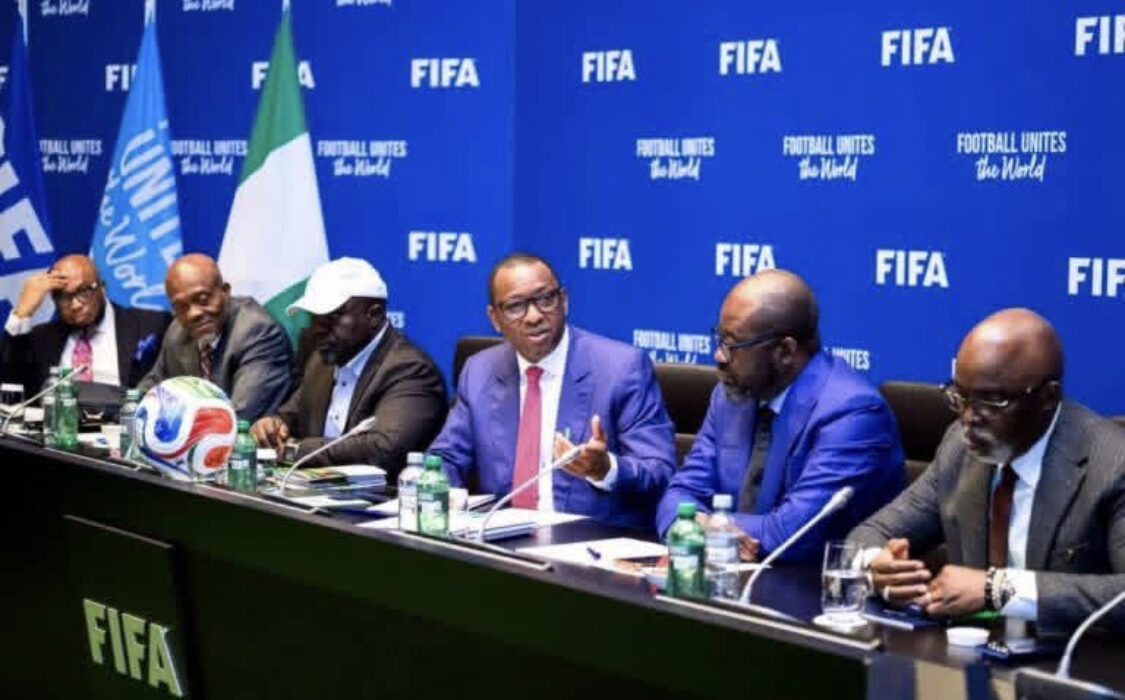
National Sports Commission (NSC) Chairman Shehu Dikko says FIFA and the Confederation of African Football (CAF) are continuing to work with Nigeria towards an inclusive roadmap for comprehensive reforms of the country’s football administration.
Dikko made the clarification in an interview with ARISE NEWS, The discussions came after the mass resignation of the Nigeria Football Federation’s principal officers and Executive Committee members on August 27, a development that triggered a wider process involving the Federal Government, FIFA, CAF and the NFF administration.
FIFA formally accepted the resignations on September 1 and confirmed that engagements with the Nigerian government, the NFF administration and CAF would continue towards a new reform roadmap. The NFF said the roadmap is expected to address reforms in the short, medium and long term and produce an inclusive new structure capable of providing a peaceful and stable environment for Nigerian football.
Dikko, who led the Nigerian delegation to the Zürich meeting, said the process must be conducted in accordance with FIFA and CAF statutes and the relevant rules governing international football.
The Zürich delegation included NSC Director-General Bukola Olopade, former NFF president and former FIFA Council member Amaju Pinnick, NFF Acting General Secretary Dr Emmanuel Ikpeme and NFF Director of Legal Services Okey Obi. CAF was represented by its Second Vice-President Kurt-Okraku, while FIFA’s Director of Member Associations for Africa, Gelson Fernandes, also participated.
Dikko said the objective is not merely to replace individuals but to create a stronger institutional framework for Nigerian football.
“Mutual engagement among the National Sports Commission, the NFF administration and the Confederation of African Football is ongoing with FIFA on the comprehensive reforms of Nigeria football,” Dikko said after the Zürich discussions.
He added that the parties were working towards an agreed roadmap in accordance with the applicable rules, regulations and statutes, expressing confidence that Nigerian football would emerge “much better and properly-structured” at the end of the process.
The reform discussions are taking place against the background of President Bola Tinubu’s August 27 directive for a comprehensive restructuring of Nigerian football.
The President specifically identified governance, administration, stakeholder representation, development pathways, domestic competitions and accountability as areas requiring attention, while directing the NSC chairman to work with the NFF Secretariat and relevant stakeholders and engage FIFA and CAF without compromising Nigeria’s international football obligations.
The first transition measures have already been implemented. Following the resignations, Dr Emmanuel Ikpeme was appointed to oversee the NFF Secretariat as interim General Secretary, while Dr Ademola Olajire became interim Deputy General Secretary. The NFF also suspended preparations for the previously scheduled elective congress and said a fresh electoral process would begin after the comprehensive reform process.
The administration of the country’s professional and lower leagues has also been placed under interim arrangements, with league chairmen, appointed directors and chief executives directed to hand over administrative responsibilities to NFF-staff COOs, or to newly deployed COOs where necessary.
Normalisation committee still not officially confirmed
While there has been speculation that the reform process could ultimately lead to an independent normalisation committee, neither FIFA nor the NFF’s official Zürich communiqué has formally announced such a committee.
The confirmed position at this stage is that FIFA, CAF, the NSC, the NFF administration and other relevant stakeholders will continue consultations to develop the roadmap.
That distinction is important because the current process has not yet produced a publicly announced final governance structure.
What has been formally established is the principle of an inclusive reform process designed to deliver a new NFF structure and a fresh electoral process after the reforms are concluded.
The reform agenda also comes as Nigeria confrontstryuy longstanding concerns over football development and institutional capacity.
Only days before the leadership crisis, the NFF had hosted a FIFA-supported workshop on Nigeria’s amateur football environment, with FIFA experts examining the country’s grassroots and amateur football structures and comparing them with systems in other member associations.
The current FIFA-CAF engagement therefore provides an opportunity for Nigeria to address the football system more broadly — from federation governance and elections to grassroots development, youth pathways, domestic competitions, infrastructure, financial accountability and the relationship between the NFF and State Football Associations.
For Dikko and the NSC, the immediate task is to maintain continuity while ensuring that the reform process remains compliant with international football statutes.
For FIFA and CAF, the challenge is to support a transition that is credible to Nigerian stakeholders while preserving the country’s standing within the international football system.
The Zürich meeting has therefore moved Nigeria’s football crisis from a leadership vacuum towards a formal reform process — but the most consequential decisions, including the eventual governance structure and electoral arrangements, are still to be agreed.