


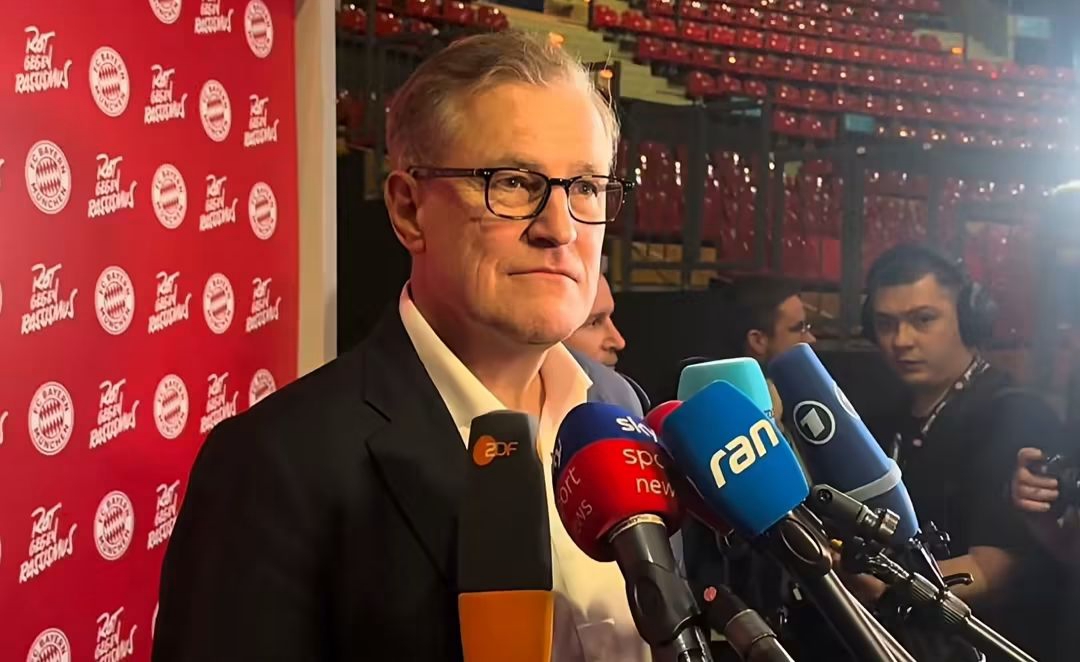
Bayern Munich chief executive Jan-Christian Dreesen has defended the club’s handling of the controversy surrounding Jamal Musiala, insisting that the German champions are not attempting to pressure the midfielder over his performance levels or contractual obligations as he continues his recovery from a series of health setbacks.
Dreesen made the clarification in an extensive interview following Musiala’s return to Bundesliga action on Friday, November 20, when the 23-year-old came off the bench in Bayern’s 1-1 draw against 1. FC Köln at the Allianz Arena.
The appearance marked Musiala’s first competitive outing in approximately two months after a muscle injury sustained during the September international break.
Addressing questions about recent comments from Bayern’s senior leadership, Dreesen maintained that the club wants the attacking midfielder to regain his previous form but must give him sufficient time to recover before making any assessment of his long-term sporting prospects.
He also dismissed suggestions that Bayern had discovered previously undisclosed medical information or felt deceived during negotiations over Musiala’s contract extension.
Asked whether the club knew about Musiala’s neurological dysfunction before he signed his current agreement, Dreesen responded that this was not the case.
“We’re certainly not going to talk about Jamal’s illness or the dysfunction here today, but you can assume that was not the case,” he said.
Dreesen further rejected the suggestion that Bayern felt misled during the negotiations, insisting that the issue was not a concern for the club.
Hoeneß Remarks Trigger First Major Controversy
The controversy surrounding Musiala’s future initially intensified following comments by Bayern honorary president Uli Hoeneß during an appearance on Bayerischer Rundfunk’s *Der Sonntags-Stammtisch* programme on November 8.
As reported by CMSports in its November 9 publication, *Bayern Munich Face Musiala Dilemma as Hoeneß Raises Concerns Over Star’s Long-Term Future*, Hoeneß openly questioned whether the Germany international would ever recover the level of performance that made him one of Europe’s most exciting attacking players.
The Bayern powerbroker described the club’s position as a dilemma, explaining that Musiala’s neurological condition could be managed through medication but was not easily curable.
He also raised the financial implications of the situation, pointing out that Bayern continued to honour the midfielder’s lucrative contract despite uncertainty surrounding his future performances.
“With him, we are in a dilemma. He has an illness that cannot simply be cured, but can be managed to some extent with medication,” Hoeneß said.
His subsequent remarks about the possibility of Bayern questioning the contractual arrangement attracted considerable attention, particularly because Musiala had committed his future to the club until 2030.
Although Hoeneß did not announce any decision to reduce the player’s wages or terminate his agreement, his comments opened a wider debate about the relationship between Musiala’s health, sporting value and financial commitments.
Dreesen and Rummenigge Add to the Debate
The situation gathered further momentum after Dreesen addressed Musiala’s circumstances during an appearance at an Abendzeitung München event on November 18.
At the time, the Bayern chief executive confirmed that the midfielder was expected to return against Köln, while acknowledging that he would need time to rediscover his previous level.
Dreesen said the club would eventually assess his progress and, if necessary, hold discussions with Musiala’s family and representatives.
“We hope that Jamal comes back. He will certainly need his time to improve again. We will assess it and, if necessary, sit down with the family and management,” he explained.
He added that Bayern would be pleased if the midfielder returned to his previous level but would have to discuss the situation if he developed into a different player.
Following Friday’s draw against Köln, former Bayern chief executive and current supervisory board member Karl-Heinz Rummenigge also made comments that further intensified the controversy.
Speaking to Sky Germany, Rummenigge questioned whether Musiala could regain his previous performance level and raised concerns about the financial implications of his contract.
He suggested that Bayern might eventually need to discuss the arrangement with the player, his family and representatives, arguing that the substantial financial terms could become difficult to justify if Musiala could no longer deliver at the level anticipated when the agreement was signed.
Rummenigge also expressed doubts about whether another club would be willing to acquire the midfielder under his existing contractual terms.
CMSports subsequently examined those remarks in its November 21 report, *Bayern’s Musiala Dilemma Deepens as Rummenigge Raises Financial Concerns Despite Comeback*.
Dreesen Rejects Claims of Pressure
In his latest interview, Dreesen attempted to clarify the intentions behind the statements from Bayern’s senior figures, insisting that the objective was not to place additional pressure on Musiala.
Asked whether Rummenigge’s comments were intended to put the player under pressure, he said:
“I don’t think Karl-Heinz Rummenigge wanted to put pressure on Jamal Musiala. I think he simply expressed that we wish Jamal to become the old Jamal again and that we’ll look at it closely.”
Dreesen also defended the club’s decision to manage Musiala’s return gradually, explaining that his appearance against Köln had been planned irrespective of the number of players unavailable through injury.
He stressed that the midfielder was never expected to complete an entire match immediately after spending two months on the sidelines.
“Once again: I was very, very happy yesterday that he was first on the bench and then also played. He would have done that either way, no matter how many injured players we had beforehand,” Dreesen explained.
“That was agreed, and it’s the first step, like with everyone who’s been out for a long time. He’s had an injury for two months, and you can’t expect him to play a full game.”
The CEO added that Musiala must be allowed sufficient time to regain his fitness before the club evaluates his progress.
According to Dreesen, the next meaningful assessment will take place at the beginning of 2027, after the midfielder has had several months to work towards his previous performance level.
Contract Remains Until 2030
Dreesen also rejected suggestions that Bayern were preparing to reopen Musiala’s contract or introduce changes to its terms.
Asked about the legal basis for any possible contractual adjustments, he insisted that there was no reason to continue discussing the agreement because the immediate issue concerned the player’s recovery from injury.
“We have a contract until 2030, it’s clear-cut, so there is no discussion,” he said.
He further maintained that no concrete proposal to change the contractual arrangement had been publicly presented and described suggestions of an impending renegotiation as interpretations of the club’s statements.
Dreesen also declined to reveal whether Musiala or his representatives had responded to Hoeneß’s comments, explaining that Bayern would not discuss confidential internal conversations through the media.
FIFPRO Raises Concerns Over Bayern’s Public Comments
The controversy has since attracted criticism from FIFPRO, the global footballers’ union, which expressed serious concern about the public discussion of Musiala’s health and contractual situation while he continues his recovery.
In a statement released on November 21, FIFPRO accused Bayern’s senior leadership of pursuing what it described as a coordinated strategy to put pressure on the player and his representatives ahead of any potential negotiations.
The union argued that uncertainty surrounding a player’s future could negatively affect their mental well-being, particularly during a period of injury rehabilitation.
It also stressed that contractual concerns should be addressed privately between clubs and players rather than through public statements.
FIFPRO maintained that injuries or temporary declines in performance do not provide a club with grounds to disregard or reopen contractual commitments.
Background: Musiala’s Injury and Neurological Condition
Musiala’s recent difficulties followed a devastating injury during Bayern’s FIFA Club World Cup quarter-final against Paris Saint-Germain on July 5, 2025.
The attacking midfielder suffered a fractured fibula accompanied by a broken and dislocated ankle following a collision involving PSG goalkeeper Gianluigi Donnarumma.
Bayern subsequently confirmed that the 22-year-old required surgery and would be unavailable for several months.
The injury represented a major setback for Musiala, who had only recently returned from an earlier fitness problem and was beginning to regain his rhythm.
He later underwent a prolonged rehabilitation programme before returning to competitive football.
However, another health concern emerged in August 2026 when Musiala collapsed during Bayern’s pre-season friendly against RB Leipzig and experienced a similar incident four days later against Heidenheim.
Following the second incident, Musiala personally disclosed that he had been diagnosed with temporary but treatable absence seizures resulting from a neurological dysfunction.
He reassured supporters that he was receiving specialist medical care and that, according to the medical advice he had received, there was no additional health risk.
The midfielder also requested privacy regarding the condition while expressing optimism about continuing his football career.
Musiala Makes Bundesliga Return
After managing the neurological condition and recovering from his subsequent muscle injury, Musiala finally returned to competitive action against Köln on November 20.
The Germany international entered the match in the 70th minute, replacing Konrad Laimer, as Bayern settled for a 1-1 draw.
His return also coincided with Vincent Kompany’s return to the technical area after the Bayern manager’s own health-related absence.
Although Musiala’s appearance represented an encouraging step in his rehabilitation, it remains too early to determine whether he can immediately reproduce the performances that previously established him as one of Bayern’s most important attacking players.
For now, Dreesen insists the club’s priority is to give the midfielder time, while the public disagreement over how Bayern’s leadership has addressed his future continues to attract attention.
Musiala remains under contract with Bayern until June 2030, and the club has made no official announcement of plans to terminate or reduce the terms of that agreement.