


By Kazeem Ajibola Shoyebo
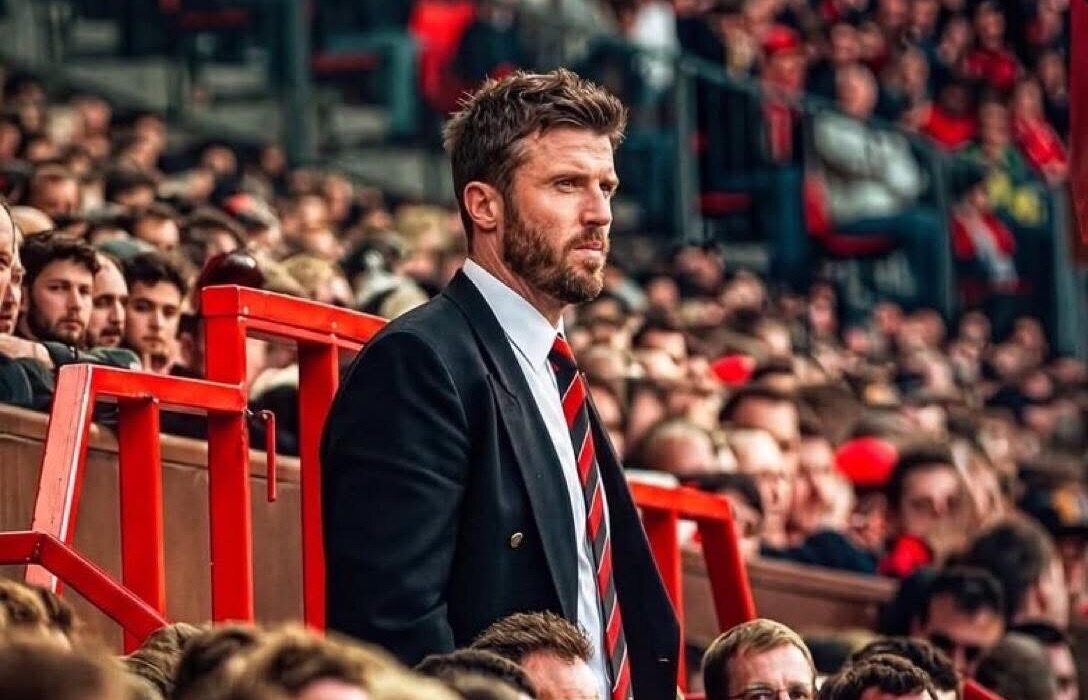
When Michael Carrick was handed interim control of Manchester United following the dismissal of Rúben Amorim, the reaction was largely underwhelming. For many, it felt like a holding move rather than a bold reset, an internal appointment made to steady the club while the hierarchy searched for a more high-profile solution.
Carrick has not only stabilised a faltering season but has also reignited belief at a club that had appeared to be drifting. United have secured qualification for the UEFA Champions League after two seasons away, and suddenly the question being asked is no longer about who should replace Carrick—but whether he should be replaced at all.
Carrick inherited a dressing room clouded by uncertainty. Under Amorim, results had failed to match expectations despite significant backing from the board. United struggled for consistency in the Premier League, and reports of internal tensions only deepened concerns about the team’s direction.
The atmosphere had grown strained, with disagreements involving senior figures, including captain Bruno Fernandes, highlighting fractures within the squad. Performances reflected that instability, and by the time Amorim departed, United were outside the Champions League places and lacking a clear identity.
Carrick’s arrival did not come with sweeping declarations or radical overhaul. Instead, it brought clarity.
He simplified the approach, restored structure, and, crucially, reconnected with the players. The effect was almost immediate. United began to look organised again, more composed in possession, and more resilient without the ball.
The numbers underline the transformation. In 17 matches under Carrick, United have recorded 12 wins, three draws and just two defeats, a run that has propelled them back into the top four.
Beyond consistency, it is the calibre of victories that has turned heads. Carrick’s United have beaten some of the biggest names in the league, including Pep Guardiola’s Manchester City, Mikel Arteta’s Arsenal FC, and Arne Slot’s Liverpool FC. Wins over Unai Emery’s Aston Villa and Liam Rosenior’s Chelsea FC further reinforced the sense of a team rediscovering its competitive edge.
At Old Trafford, the shift has been just as visible in the stands as on the pitch. Supporters, once restless, have found a new voice—chanting “It’s Carrick, you know!” as belief returns to the stadium.
Carrick’s influence has extended beyond results. He has re-established a sense of unity within the squad, easing tensions and creating an environment where players appear more aligned.
Key figures have responded with improved performances, while younger players have shown renewed confidence. The team now plays with clearer intent, blending discipline with attacking freedom, an identity that had been missing earlier in the campaign.
Despite the growing calls for him to remain in charge, Carrick has maintained a measured stance on his future.
“It’s not me who gets to choose,” he said recently. “I am just working hard.”
It is a response that reflects both humility and focus—traits that have defined his approach since stepping into the role.
Manchester United’s hierarchy now face a significant decision. What was initially viewed as a temporary fix has evolved into a compelling case for continuity.
Carrick’s tenure has demonstrated that stability, clarity and connection can sometimes outweigh reputation. He has delivered results, restored confidence and brought the club back to Europe’s top table.
Whether Carrick is ultimately appointed on a permanent basis remains to be seen. But what is no longer in doubt is his impact.
He arrived as a stopgap. He has performed like a solution.
For a club searching to rediscover its identity and return to its former heights, Carrick may not just be part of the answer—he might be the missing link.