


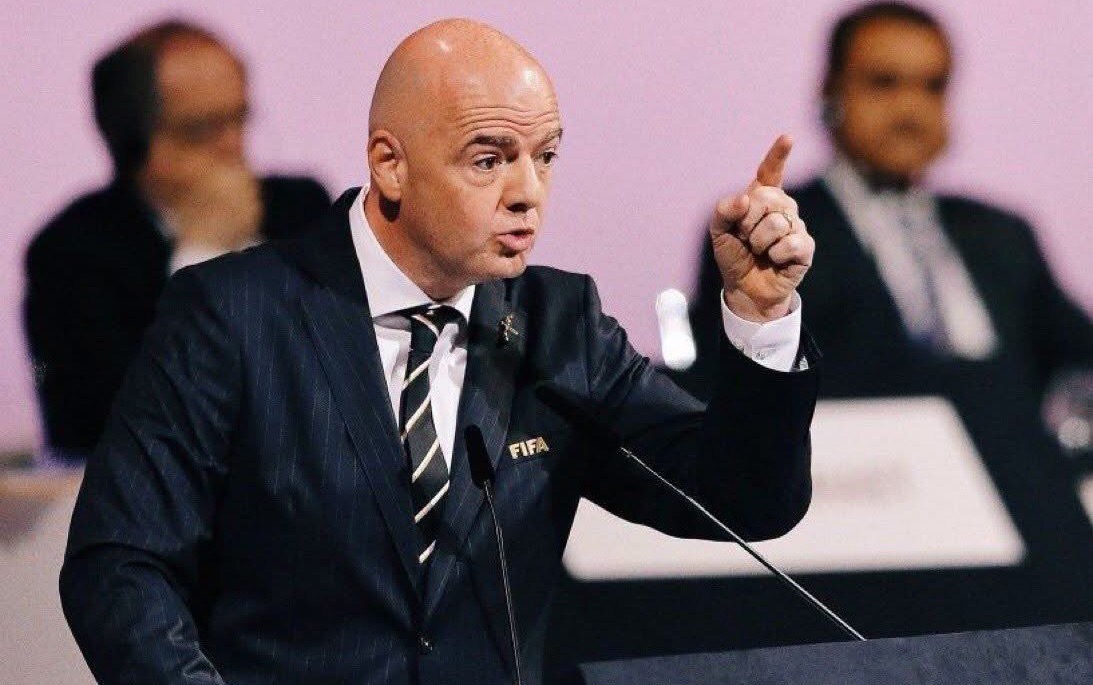
European football leaders are reportedly exploring alternative candidates, but the FIFA president remains the favourite thanks to strong support from Africa, Asia and CONCACAF
FIFA President Gianni Infantino is facing his strongest political challenge in years as several UEFA member associations reportedly seek to unite behind an alternative candidate ahead of the next FIFA presidential election.
Although Infantino is expected to seek another term and remains the overwhelming favourite, growing unease within European football has triggered discussions about whether the governing body should be led in a different direction.
The debate comes amid heightened scrutiny of FIFA’s governance following the controversy surrounding the suspension of United States striker Folarin Balogun during the 2026 FIFA World Cup. Critics within Europe argue that the episode has intensified concerns over transparency, institutional independence and political influence within football’s governing body. FIFA has consistently maintained that its independent judicial bodies handled the matter without interference.
According to multiple reports, UEFA federations have discussed several prominent names who could potentially oppose Infantino.
Foremost among them is UEFA president Aleksander Čeferin, widely regarded as the strongest possible challenger because of his experience leading European football. However, reports indicate that Čeferin has little appetite for a direct confrontation and prefers to continue serving as UEFA president.
Paris Saint-Germain president and European Club Association chairman Nasser Al-Khelaifi has also emerged as a name favoured by several European associations, including Belgium and Poland. Despite that support, sources suggest Al-Khelaifi currently has no intention of entering the presidential race.
Another figure reportedly discussed is Legia Warsaw owner Dariusz Mioduski, who is said to have attracted interest from a number of European federations. Poland is reportedly prepared to support his candidacy should Al-Khelaifi ultimately decline to run.
Despite those conversations, football’s political arithmetic still appears to favour Infantino.
The Swiss-Italian administrator continues to enjoy substantial backing from member associations across Africa (CAF), Asia (AFC) and North and Central America (CONCACAF), giving him a significant advantage under FIFA’s one-member, one-vote electoral system.
Several member associations have publicly supported FIFA’s ambitious expansion agenda under Infantino, including proposals to increase the men’s World Cup to 64 teams for the tournament’s centenary edition in 2030 and the introduction of an expanded FIFA Club World Cup. Those initiatives have proved particularly popular among many developing football nations, which see them as opportunities for greater participation and increased financial returns.
Infantino, first elected in 2016 following the departure of Sepp Blatter, has already secured two previous re-elections without opposition. Under FIFA statutes, presidents are elected by the FIFA Congress, where each of the 211 member associations has an equal vote regardless of footballing stature.
While frustration within parts of Europe appears to be growing, assembling a unified challenger capable of attracting worldwide support remains a formidable task.
Unless a consensus candidate emerges, Infantino is expected to enter the election as the clear favourite to extend his decade-long leadership of world football.
Whether Europe can transform dissatisfaction into a credible electoral challenge may ultimately determine whether FIFA witnesses its first genuinely contested presidential race in years.