


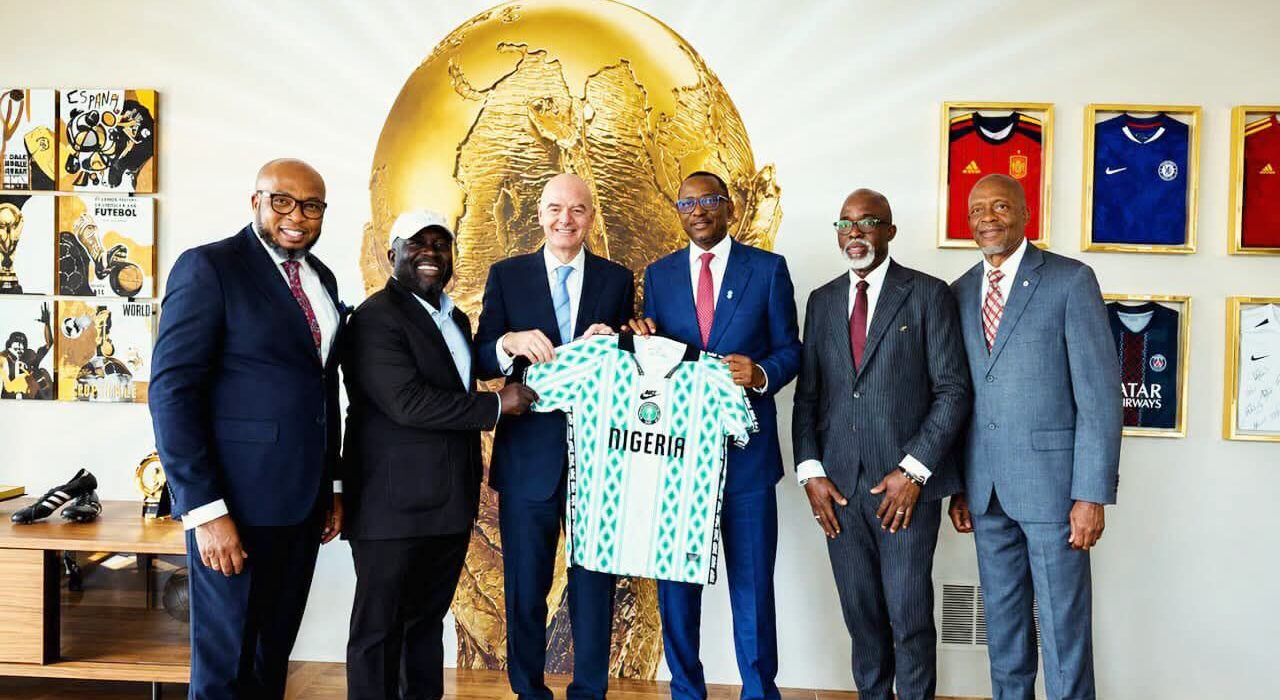
I’m Nigeria’s drive to overhaul its football administration has received a significant boost after the National Sports Commission (NSC) held high-level discussions with FIFA President Gianni Infantino in Zurich on Tuesday, with the parties agreeing to continue work on a comprehensive reform roadmap for Nigerian football.
The meeting, held at the FIFA headquarters, came days after the resignation of former Nigeria Football Federation (NFF) President Ibrahim Gusau, General Secretary Mohammed Sanusi and members of the NFF Executive Committee, developments that triggered fresh uncertainty over the administration of Nigerian football and speculation about possible FIFA sanctions. The NFF has since clarified that FIFA has accepted the resignations and that discussions on the reform process are ongoing.
The Nigerian delegation was led by NSC Chairman, Mallam Shehu Dikko, and included NSC Director-General Bukola Olopade, NFF Acting General Secretary Dr Emmanuel Ikpeme and NFF Director of Legal Services Okey Obi. Former NFF President and ex-FIFA Council member Amaju Pinnick also attended in his official capacity as Special Adviser to the CAF President and Deputy Chairman of the FIFA Men’s National Teams’ Competitions Committee. CAF Second Vice-President Kurt-Okraku and FIFA Director of Member Associations for Africa, Gelson Fernandes, were also part of the discussions.
Infantino said the meeting provided an opportunity to align FIFA and Nigeria around the future of the game, with discussions extending beyond immediate competitions to the institutional foundations of Nigerian football.
“I was pleased to sit down with a delegation from Nigeria, led by National Sports Commission (NSC) Chairman Shehu Dikko, at the Home of FIFA in Zürich to hold important discussions and align on our vision for football in the country,” Infantino said.
According to the FIFA president, the talks focused on institutional, governance and developmental issues, alongside existing areas of cooperation between FIFA and Nigeria. He also stressed the importance of stronger structures and clearer pathways capable of providing greater opportunities for young Nigerians.
The emphasis on institutional development is significant given FIFA’s broader strategic focus on governance, development and stronger member associations. FIFA says its Forward programme has increased direct development funding to member associations, while its current strategic objectives also place emphasis on governance, regulatory reform and youth development.
Dikko said the engagement with FIFA and CAF would help ensure that the Nigerian reform process produces a properly structured football system rather than merely replacing individuals in positions of authority.
“Mutual engagement among the National Sports Commission, the NFF administration and the Confederation of African Football is ongoing with FIFA on the comprehensive reforms of Nigeria football, including agreeing a roadmap going forward in accordance with the relevant rules, regulations and Statutes,” Dikko said.
He expressed confidence that Nigerian football would emerge “much better and properly-structured” once the process is concluded.
The development also provides an important clarification amid reports that FIFA could punish Nigeria following the mass resignations at the NFF. The federation has categorically dismissed a purported FIFA letter circulating over the issue as fake and said FIFA had already accepted the resignations of the former principal officers and Executive Committee members.
The Zurich engagement therefore represents a potentially decisive moment for Nigerian football. Rather than an isolated leadership change, the process is now being framed around a broader restructuring of governance, development pathways, administration and institutional capacity, with FIFA and CAF involved in discussions over the roadmap.
For a country whose football system has produced generations of elite talent but has recently suffered serious setbacks across several national-team categories, the challenge will be to convert the diplomatic agreement in Zurich into measurable institutional reforms at home.