


Tunisia’s 2026 FIFA World Cup campaign came to a disappointing end on Friday as the Carthage Eagles suffered a 3-1 defeat to the Netherlands, completing a winless group-stage campaign that saw them finish without a point for the first time in the nation’s World Cup history.
The defeat not only confirmed Tunisia’s early elimination but also extended their losing streak to five consecutive matches across all competitions—the country’s worst run since August–September 1987—capping a tournament that fell well below expectations.
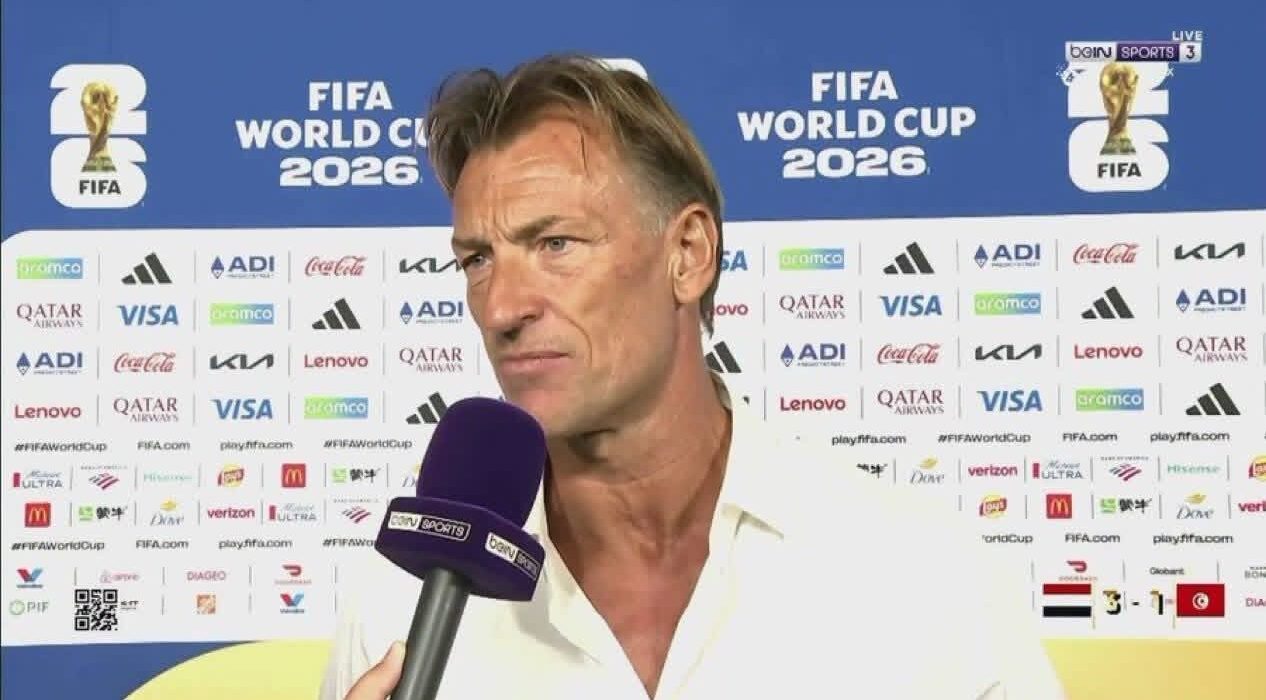
Speaking after the match, head coach Hervé Renard accepted responsibility for the disappointing campaign and issued a heartfelt apology to the Tunisian people.
“I’m sorry and I apologize to the Tunisian fans. I gave everything I had.”
The Frenchman, who took charge of Tunisia with the ambition of leading the North Africans deep into the tournament, acknowledged the pain of the early exit while refusing to speculate on whether he would remain in charge.
“We haven’t discussed the future yet. We’ll see. Today, we are ending our World Cup journey. There was an initial agreement, but everything can change.”
His comments have inevitably fuelled speculation over his future, with the Tunisian Football Federation expected to review the team’s performances before deciding on the next phase of the national team’s project.
On the pitch, Tunisia endured a nightmare start against an impressive Dutch side.
The Netherlands took the lead in just the third minute when Ellyes Skhiri inadvertently turned the ball into his own net, recording one of the fastest own goals in FIFA World Cup history. The unfortunate moment placed Skhiri alongside Carlos Gamarra (2006) and Sead Kolašinac (2014), who also scored own goals in the third minute of World Cup matches.
Four minutes later, Brian Brobbey doubled the Oranje’s advantage, leaving Tunisia two goals behind inside seven minutes. The Dutch striker continued his outstanding tournament by scoring for the third time in three matches, while the Netherlands became only the sixth nation in FIFA World Cup history to score twice within the opening seven minutes of a match.
Despite the disastrous opening, Tunisia showed admirable determination after the break.
Hazem Mastouri reduced the deficit in the 54th minute to briefly revive hopes of an unlikely comeback, but Jan Paul van Hecke restored the Netherlands’ two-goal cushion eight minutes later, effectively ending the contest and sealing a 3-1 victory for Ronald Koeman’s side.
The result ensured the Netherlands advanced confidently to the Round of 32, where they will face Morocco in one of the standout ties of the knockout stage.
For Tunisia, however, the final whistle marked the end of a campaign filled with frustration and unwanted records.
For the first time since making their FIFA World Cup debut in 1978, the Carthage Eagles failed to collect a single point during the group stage. Defensive lapses, an inability to recover from slow starts, and missed opportunities proved costly throughout the tournament, ultimately condemning them to an early exit.
The disappointing campaign has also added an unwanted statistic to Renard’s managerial record. The defeat was his sixth in eight FIFA World Cup matches as a head coach, giving him a 75 percent loss rate at the tournament. Among coaches to have managed at least eight World Cup matches, only Hernán Darío Gómez has recorded a higher defeat percentage.
Nevertheless, Renard’s achievements on the African continent—including leading Zambia and Côte d’Ivoire to Africa Cup of Nations titles—ensure his legacy remains intact, even if his spell with Tunisia ends after this tournament.
As the dust settles, attention will now turn to the future of Tunisian football. The painful lessons from this World Cup are likely to prompt reflection within the federation as preparations begin for the next qualification cycle.
For now, though, the overriding emotion is one of disappointment. A campaign that began with hope has ended in heartbreak, leaving Tunisia searching for answers after one of the most difficult World Cup performances in the nation’s history. Whether Hervé Renard remains the man to lead that rebuilding process is a question that, by his own admission, has yet to be answered.