


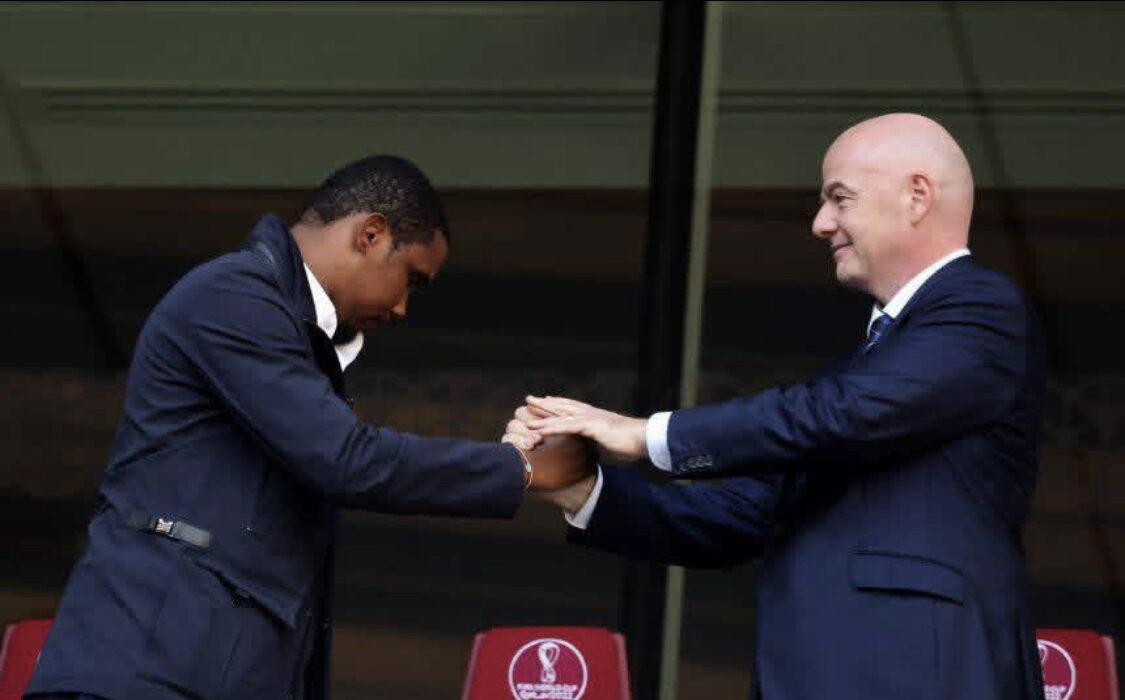
Former Cameroon captain and current FECAFOOT president Samuel Eto’o has publicly defended FIFA president Gianni Infantino, rejecting suggestions that the Swiss-Italian administrator has done anything wrong amid mounting criticism of his leadership.
Speaking to CNN Sports, Eto’o argued that the timing of the controversy should be viewed in the context of the forthcoming FIFA presidential election, where Infantino is seeking another term.
“I don’t think that President Gianni Infantino has done anything wrong. I think the timing of all of that is because there’s an election coming up, when Gianni Infantino is standing. All of this has happened because there’s an election coming up, that’s all there is.”
Eto’o’s intervention comes as Infantino faces increasing scrutiny over the now-abandoned FIFA Forward Enterprise proposal, which involved bringing private investment into FIFA’s commercial structure. The proposal generated opposition from several football stakeholders and contributed to wider questions about FIFA’s governance and the direction of world football.
The former Barcelona and Inter Milan forward also praised Infantino’s tenure, particularly his impact on the expansion of global football and opportunities created for smaller football nations and associations.
Eto’o’s position broadly mirrors that of the Confederation of African Football (CAF), whose president Patrice Motsepe has continued to back Infantino ahead of the 2027 FIFA presidential election. At the same time, UEFA, the Asian Football Confederation and CONCACAF have been among the bodies expressing serious concerns about FIFA’s recent direction.
The comments add an important African voice to an increasingly intense debate over Infantino’s leadership. With the 2027 FIFA presidential election approaching, the divide between supporters and critics of the incumbent is likely to remain a major issue in global football governance.
For Eto’o, however, the focus remains on what he considers Infantino’s contribution to football development and the opportunities created for countries that have traditionally had less influence on the global stage.