


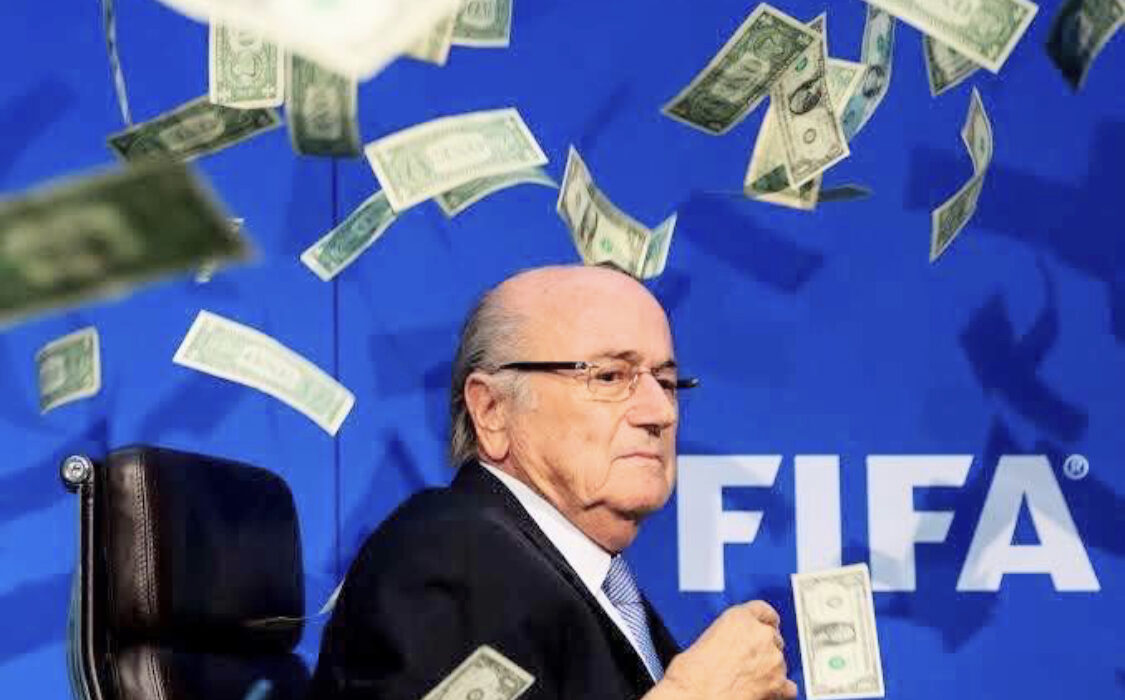
Former FIFA president Sepp Blatter has launched a scathing attack on world football’s governing body following its controversial decision to suspend Folarin Balogun’s automatic one-match ban, warning that disciplinary rulings must never be influenced by political intervention.
Blatter’s comments come amid growing international backlash after FIFA cleared the United States striker to play in the Americans’ FIFA World Cup Round of 16 clash against Belgium, despite Balogun receiving a straight red card in the previous round against Bosnia and Herzegovina. FIFA confirmed that the suspension attached to the dismissal had been suspended for one year, making the Monaco forward immediately eligible for selection.
The decision has generated one of the biggest controversies of the tournament after reports that U.S. President Donald Trump personally contacted FIFA president Gianni Infantino to request a review of Balogun’s automatic suspension. Neither FIFA nor the White House has publicly confirmed the details of those conversations, but the reports have fuelled widespread concerns about the independence of football’s disciplinary process.
Blatter, who led FIFA from 1998 to 2015, argued that disciplinary matters should be governed exclusively by regulations and independent judicial bodies.
“Red cards are not overturned through political phone calls. They are overturned according to the regulations, the evidence, and the decisions of independent bodies. Football must never become an arena for political influence.”
The 90-year-old went further by questioning the direction of football’s global governing body.
“If a U.S. President intervenes with the FIFA President—and a player is suddenly cleared before a World Cup knockout match—the question is unavoidable: Quo vadis, FIFA?”
Blatter’s remarks have added to an expanding chorus of criticism from across the football world.
UEFA described FIFA’s decision as having “crossed a red line,” arguing that an automatic suspension following a red card is embedded in the Laws and disciplinary regulations and should not become subject to exceptions during an ongoing tournament. The European governing body warned that inconsistent application of the rules risks undermining both the integrity and credibility of the FIFA World Cup.
Belgium, who were scheduled to face the United States in the Round of 16, also reacted angrily, with the Royal Belgian Football Association exploring its legal options and questioning the legality of the decision. Belgium manager Rudi Garcia criticised the ruling, while former Liverpool manager Jürgen Klopp also voiced concerns over the precedent it could set for international football.
The controversy has centred not only on Balogun’s eligibility but also on the wider principle of sporting autonomy.
Under FIFA’s disciplinary framework, a player sent off with a straight red card ordinarily serves an automatic suspension. Critics argue that any deviation from that principle must be clearly justified through established legal procedures rather than extraordinary intervention, particularly during a World Cup.
FIFA has maintained that its disciplinary bodies acted within the provisions of its disciplinary code when suspending Balogun’s ban, although the governing body has offered only limited public explanation regarding the legal reasoning behind the decision.
The case has quickly evolved beyond the United States and Belgium, becoming a broader debate about governance, transparency and the separation of politics from football administration.
Although Blatter himself remains one of the most controversial figures in FIFA’s history, having resigned in 2015 amid a corruption crisis and later receiving a ban from football-related activities, his latest intervention has resonated because it touches on one of the sport’s most fundamental principles: that disciplinary decisions must be applied consistently, regardless of the stature of the player, the nation involved or external political pressure.
As scrutiny over FIFA’s handling of the Balogun case intensifies, Blatter’s warning has become one of the defining responses to the controversy.
For the former FIFA president, the issue extends far beyond a single red card. It is about preserving confidence that football’s biggest decisions are determined by its rules—not by influence beyond the pitch.