


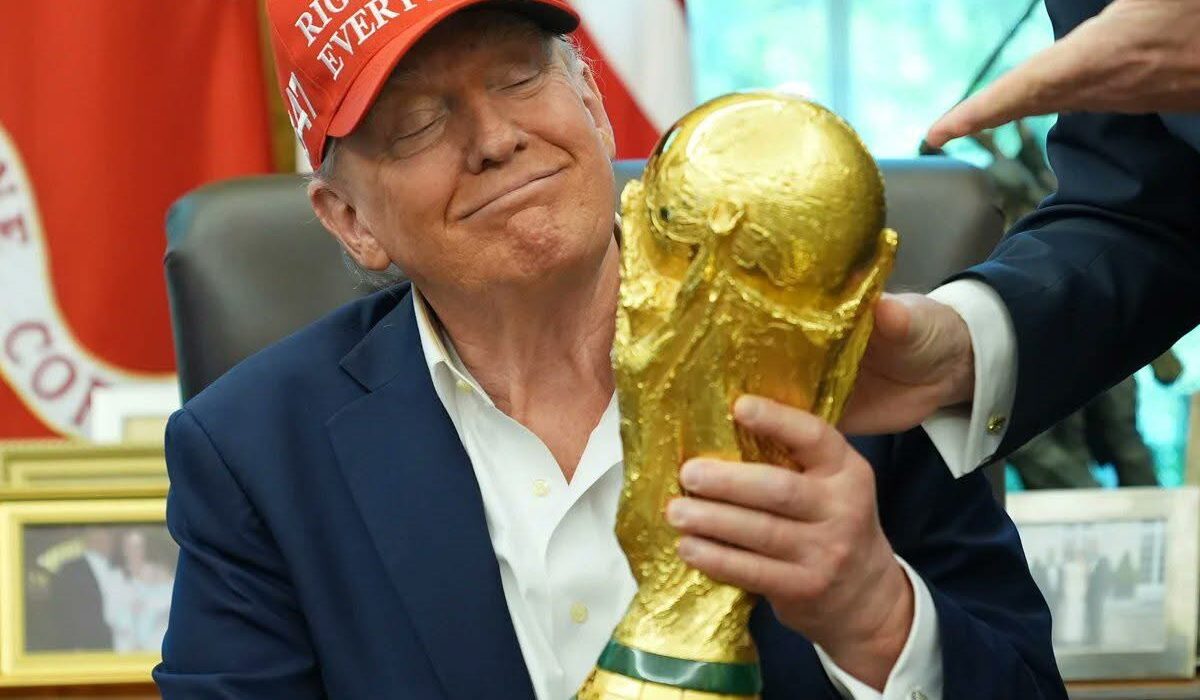
U.S. President Donald Trump has publicly confirmed that he personally contacted FIFA president Gianni Infantino to seek a review of the red card shown to United States striker Folarin Balogun, an admission that is likely to intensify the growing controversy surrounding one of the most disputed disciplinary decisions of the 2026 FIFA World Cup.
Speaking after FIFA suspended Balogun’s automatic one-match ban—allowing the Monaco forward to feature in the United States’ Round of 16 clash against Belgium—Trump acknowledged that he had spoken directly with Infantino about the incident.
“I asked for a review by FIFA. I spoke to a man [Gianni Infantino] who is highly respected, and by the way, whose level of respect has gone up tenfold.”
Trump argued that Balogun’s dismissal against Bosnia and Herzegovina should never have resulted in a straight red card, insisting the challenge had been misinterpreted by the match officials.
“It wasn’t a foul, and wasn’t even an infraction. These were two great athletes who got tangled up.”
The U.S. President also questioned the performance of the referee who issued the red card, while stopping short of making direct allegations.
“The referee, who is a little bit suspect if you check his past. I don’t want to say that because I don’t like to create controversy, but very suspect.”
Trump’s remarks represent the first public confirmation that he personally sought FIFA’s intervention, a revelation that is likely to fuel criticism from football authorities who have questioned whether political influence played a role in the governing body’s decision.
The controversy erupted after FIFA’s independent judicial bodies suspended the implementation of Balogun’s automatic one-match suspension for a probationary period of one year, making the striker immediately eligible for the United States’ knockout fixture against Belgium.
The decision has sparked fierce opposition across European football.
UEFA released an extraordinary statement accusing FIFA of having “crossed a red line,” arguing that an automatic suspension following a red card is embedded in football’s regulations and should not be subject to exceptions during a World Cup.
The Royal Belgian Football Association (RBFA) has also launched a formal challenge to Balogun’s eligibility, alleging that FIFA failed to provide the legal reasoning behind its decision and denied Belgium due process by withholding key disciplinary documents before the Round of 16 match.
Former FIFA president Sepp Blatter has warned that disciplinary sanctions should never be overturned through political intervention, stating that football “must never become an arena for political influence.” Italian National Olympic Committee president Giovanni Malagò echoed those concerns, saying the decision appeared to have “a political flavour” and risked undermining football’s meritocratic principles.
FIFA, however, has maintained that the ruling was made by its independent judicial bodies in accordance with the FIFA Disciplinary Code. The governing body has insisted that its disciplinary process remains independent, although it has not publicly released the full legal reasoning behind the decision.
Trump’s confirmation that he directly contacted Infantino is nevertheless likely to intensify scrutiny over the independence of FIFA’s disciplinary system.
While world leaders have frequently attended major sporting events and maintained relationships with football officials, it is highly unusual for a sitting head of state to publicly acknowledge lobbying the FIFA president over the eligibility of a player during an ongoing World Cup.
The episode has transformed what initially appeared to be a routine disciplinary appeal into one of the biggest governance controversies in recent World Cup history.
With UEFA, Belgium and several senior football figures continuing to question the process, Trump’s admission is expected to keep the Balogun case at the centre of debate over whether football’s rules were applied consistently—or whether politics influenced one of the tournament’s most consequential decisions.