


-
More than four decades after making my senior international debut against Morocco, I watched the Atlas Lions once again—this time from the stands—as football reminded me why memories outlive matches.
By Paul Lucky Okoku
Some football matches entertain.
Others stay with you forever.
On *June 24, 2026*, inside *Mercedes-Benz Stadium* in Atlanta, I experienced one of those unforgettable moments—not simply because Morocco defeated Haiti 4–2 in an exciting FIFA World Cup Group C encounter, but because it completed a journey that began more than forty years earlier.
Football has an incredible way of connecting generations.
It can take you back to places you never imagined revisiting—not physically, but emotionally.
As more than *68,239 spectators* filled Mercedes-Benz Stadium, I wasn’t simply watching Morocco play Haiti.
I was reliving a chapter of my own football story.
My first senior international match for Nigeria came against Morocco in Rabat on August 28, 1983.
That evening changed my football career.
Forty-three years later, I found myself watching Morocco again—no longer wearing Nigeria’s green, white jersey, but sitting among thousands of passionate Moroccan and Haitian supporters as a former international player, football analyst, and FIFA Legend honoree*.
Football had come full circle.
Great football is not defined only by who wins.
It is defined by resilience, courage, composure under pressure, and the ability to respond when adversity strikes.
Morocco demonstrated why experienced tournament teams survive difficult moments.
Haiti demonstrated why respect in football is earned, not given.
Sometimes football’s greatest victory is not lifting a trophy—it is completing a journey that began decades earlier.
Champions are not those who never fall behind. Champions are those who know how to respond when they do.
A Match Nobody Expected
Many expected Morocco to dominate comfortably.
Instead, Haiti shocked almost everyone inside the stadium.
Just ten minutes into the match, Haiti stunned the Atlas Lions by taking the lead.
The stadium suddenly became very quiet.
Morocco responded through Achraf Hakimi to make it 1–1.
Then Haiti struck again before halftime.
Once again, the underdogs were in front.
At that moment, you could sense genuine belief among the Haitian supporters.
Then came one of the biggest moments of the evening.
Deep into first-half stoppage time, Morocco equalized to make it 2–2 before halftime.
That goal completely changed the emotional direction of the match.
Experience Eventually Won
The second half revealed why Morocco has become one of Africa’s premier football nations.
They remained patient.
They trusted their system.
They increased the pressure.
They controlled possession.
They forced Haiti deeper and deeper into its own half.
Eventually, the breakthrough came.
Morocco scored twice in the final stages to secure a deserved 4–2 victory and book their place in the Round of 32.
The scoreline reflected Morocco’s quality.
The performance reflected their maturity.
The Statistics Tell Morocco’s Story
The numbers confirmed what many of us witnessed from the stands: Morocco’s superiority eventually prevailed, even after twice falling behind.
The Atlas Lions finished with a commanding statistical advantage over Haiti:
- Nearly 70% possession, compared with Haiti’s 30%.
- 19 total shots, compared with Haiti’s 7.
- 12 shots on target, forcing Haiti’s goalkeeper into repeated action.
- 9 corner kicks, reflecting Morocco’s sustained attacking pressure.
- More than 90% passing accuracy, demonstrating composure and control throughout the match.
Those statistics illustrate why Morocco ultimately overturned a two-goal deficit. They remained patient, controlled possession, created significantly more chances, and never abandoned their attacking philosophy.
But statistics alone do not tell the whole story.
They cannot measure Haiti’s courage.
They cannot measure the belief of a team that twice stunned one of Africa’s strongest nations.
And they cannot capture the emotion inside a sold-out stadium of 68,239 fans witnessing a thrilling six-goal World Cup contest.
Football is played with tactics and statistics.
It is remembered through passion, resilience, and unforgettable moments.
Haiti Lost the Match—but Won Respect
If anyone left the stadium believing Haiti did not belong at the World Cup, they were watching a different match.
This was Haiti’s return to the world’s biggest football stage after more than five decades.
They showed courage.
They showed organization.
They showed attacking ambition.
Most importantly, they showed absolutely no fear.
Twice they led one of Africa’s strongest national teams.
Twice they forced Morocco to respond.
That is not the performance of a team merely happy to participate.
That is the performance of a nation determined to compete.
For a country facing enormous economic and social challenges, Haiti gave its people something priceless—hope.
An African Supporting Africa
One moment during the match made me smile.
Surrounded by Moroccan supporters and Haitian supporters, I wondered if some Haitian fans were asking themselves:
“Why is he supporting Morocco?”
The answer was simple.
Morocco is African.
I am African.
My loyalty, on this occasion, was with my continent.
Supporting Morocco did not diminish my admiration for Haiti’s remarkable performance.
It simply reflected a lifelong belief that African football continues to grow stronger when its representatives succeed on the world’s biggest stage.
A Sell-Out Crowd, a Personal Statement, and the Spirit of the World Cup
One of the most memorable moments of the evening was not only what happened on the pitch, but what unfolded in the stands.
The FIFA World Cup Group C match between Morocco and Haiti on Wednesday, June 24, 2026, attracted an announced sell-out crowd of 68,239 spectators at Mercedes-Benz Stadium in Atlanta. Every seat was occupied as Moroccan and Haitian supporters transformed the stadium into a vibrant celebration of football. The colors, songs, flags, drums, and chants created the kind of atmosphere that only the FIFA World Cup can produce.
Amid that incredible sea of supporters, my own attire told a story.
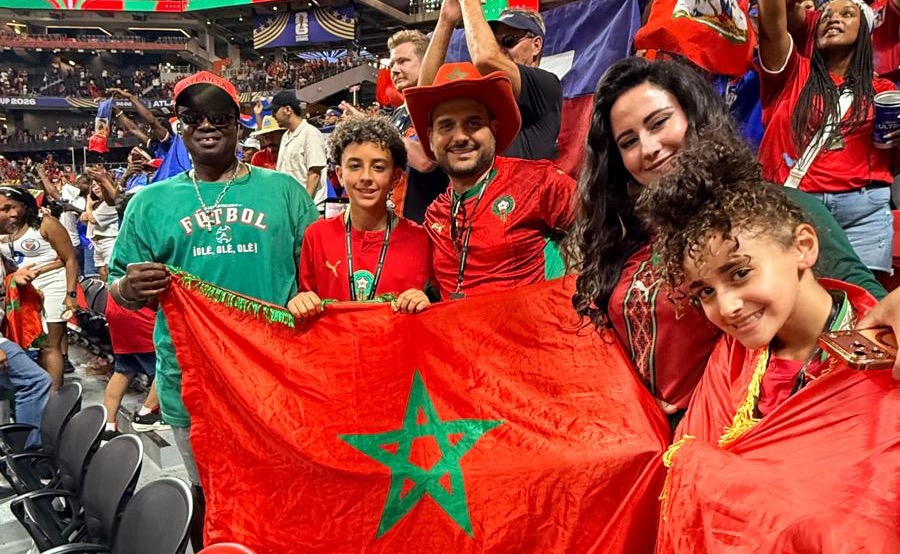
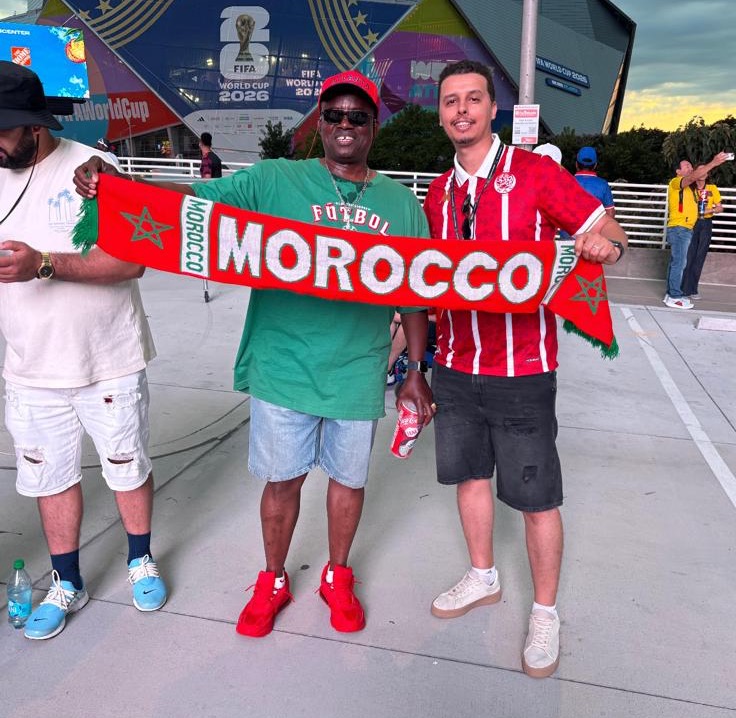
I intentionally dressed in Morocco’s national colors—a green “FÚTBOL” (Spanish for “Football”) shirt with the slogan “¡Olé, Olé, Olé!*”, a red ATLANTA cap bearing my name, “Lucky,” on the brim, and red shoes. Standing alongside a family of Moroccan nationals, I proudly joined them in holding the Moroccan flag—a moment that perfectly captured the unity, friendship, and shared passion that make the FIFA World Cup unlike any other sporting event.
Some may have wondered why a former Nigerian international was dressed in Morocco’s colors.
For me, the answer was simple.
The flag was Moroccan.
The pride was African.
When Morocco played, Africa played.
And as an African, I proudly stood with my continent.
That support did not diminish my admiration for Haiti. Quite the opposite. Haiti earned my deepest respect. They twice stunned one of Africa’s strongest teams, scored their first World Cup goals in fifty-two years, and demonstrated courage, resilience, and belief throughout the match.
They may have lost 4–2, but they left the stadium having earned the respect of football fans around the world.
Looking back, I realized that my attire represented much more than colors.
Across the front of my red cap was the word ATLANTA, proudly identifying the host city of this unforgettable World Cup experience. On the visor (brim) of the cap was my name, “Lucky,” a reminder of the remarkable football journey that had brought me from my senior international debut against Morocco in Rabat in 1983 to watching Morocco once again at the FIFA World Cup in Atlanta in 2026.
My green “FÚTBOL” (Spanish for “Football”) shirt, emblazoned with the familiar chant ”¡Olé, Olé, Olé!”, celebrated the universal language of the beautiful game. Standing alongside a family of Moroccan nationals and holding the Moroccan flag, I experienced firsthand how football transcends borders, cultures, languages, and generations.
Forty-three years earlier, Morocco had been my opponent when I made my senior international debut for Nigeria in Rabat.
On this evening in Atlanta, Morocco once again became part of my football story.
That is the beauty of the FIFA World Cup.
It is more than a tournament.
It is where memories are made, friendships are formed, and football reminds us that, despite our different flags, we all speak the same language when the whistle blows.
Africa’s Rising Voice on the World Stage
One of my greatest takeaways from this FIFA World Cup has been the continued rise of African football.
Watching teams such as Morocco, Ghana, Côte d’Ivoire, South Africa, and Senegal compete has reinforced my belief that African football is continuing to narrow the gap with the traditional powers of Europe and South America. Every tournament brings new evidence that African teams are no longer content simply to participate—they arrive expecting to compete, to challenge, and to win.
That progress fills me with pride.
Throughout FIFA Legends Week, however, one question followed me almost everywhere I went.
“Paul, what happened to Nigeria?”
I heard it from football people, supporters, and friends from different countries.
Some told me, “The World Cup doesn’t feel quite the same without Nigeria.”
Others spoke about the excitement, flair, and unmistakable green jerseys that have become part of World Cup history.
As a former Super Eagles international, I understood exactly what they meant.
Nigeria has long been one of Africa’s great football ambassadors. Its flair, passion, vibrant supporters, and iconic green jersey have enriched the FIFA World Cup for generations.
That is why our absence is felt—not only by Nigerians, but by football lovers around the world.
My hope is that the Super Eagles will soon return to where they belong: competing on football’s biggest stage and inspiring another generation of players and supporters.
African football is rising.
Nigeria should be helping lead that rise.
An Empty Seat at Africa’s Table
As I celebrated Morocco’s victory, one thought quietly stayed with me throughout the evening.
I wished Nigeria had been there.
As a former Nigerian international, there is no greater feeling than seeing your country’s flag flying at the FIFA World Cup.
Instead, I found myself proudly supporting another African nation.
That is not how it should be.
The 2026 FIFA World Cup expanded to *48 teams*, giving Africa its greatest opportunity ever, with *10 qualification places available*. Yet Nigeria, one of the continent’s traditional football powers, was absent for the *second consecutive World Cup*.
That reality should not divide us.
It should inspire us.
Nigeria has never lacked talent.
What every successful football nation needs is stability, long-term planning, sound leadership, and the patience to build a lasting football culture.
Watching Morocco and Haiti compete before 68,239 passionate supporters is reminded me what is possible when vision is matched by preparation.
My hope is that the Super Eagles will return where they belong—on football’s biggest stage.
Because the FIFA World Cup feels richer when Nigeria is part of its story.
And I look forward to the day when I will once again wear Nigeria’s green with the same pride I felt watching African football shine in Atlanta.
From Rabat to Atlanta
Watching Morocco brought back memories that have remained vivid for more than four decades.
In 1983, after Nigeria’s senior team drew Morocco in Benin City in an Africa Cup of Nations qualifier, three Flying Eagles players—*Paul Okoku* Chibuzor Ehilegbu, and Isa Shofoluwe*—were unexpectedly called into the Green Eagles squad for the decisive return leg in Rabat.
The instruction was brief:
“Get your passports.”
Within days, we travelled through Lagos and Madrid before arriving in Morocco, where all three of us played the full match as Nigeria advanced on penalties.
That experience forever connected my football journey with Morocco. More than four decades later, it was fitting to watch the Atlas Lions once again—this time from the stands—as they fought back to defeat Haiti in another memorable World Cup contest.
Football’s Enduring Gift
One of football’s greatest gifts is its ability to connect generations.
A match played decades ago can suddenly come alive through another match on the world’s biggest stage.
As I left Mercedes-Benz Stadium, I realized I had witnessed more than Morocco’s 4–2 victory over Haiti.
I had witnessed football completing a circle that began in Rabat in 1983 and continued in Atlanta in 2026.
That is why football is more than a game.
It is a lifelong journey of memories, friendships, and moments that never truly fade.
What This Match Teaches
Morocco’s victory reminds us that experience matters.
Haiti’s performance reminds us that courage matters just as much.
One team advanced.
The other earned worldwide respect.
Both left the field with their reputations enhanced.
That is what makes the FIFA World Cup unique.

Lessons for Football’s Next Generation
Football federations, coaches, and young players should study matches like this—not simply because of the final score, but because of the lessons it offers.
Winning matters.
But resilience, preparation, tactical discipline, belief, and composure under pressure matter even more.
Morocco showed why experienced teams survive difficult moments.
Haiti showed why courage and self-belief can earn respect, even in defeat.
Those qualities build champions long before trophies are lifted.
Investing in the Future of the Beautiful Game
The Morocco-Haiti encounter reinforced an important truth: football continues to grow stronger when more nations are given the opportunity to compete and develop.
African football must continue investing in youth development, coaching education, sports science, modern infrastructure, and international exposure if it is to produce even more teams capable of challenging the world’s best.
Likewise, emerging football nations such as Haiti should view this tournament as proof that sustained investment, sound leadership, and long-term planning can narrow the gap with traditional football powers.
The future of world football will be stronger when every nation believes it belongs—and has the opportunity to prove it.
More Than a Match
As the crowd slowly departed Mercedes-Benz Stadium, one thing was unmistakable.
This had been far more than a football match.
Morocco demonstrated the resilience and composure required to succeed at the highest level.
Haiti demonstrated that courage, belief, and determination can earn the admiration of the football world, even in defeat.
For more than 68,000 supporters, the evening was a celebration of competition, respect, and the unifying power of the beautiful game.
The FIFA World Cup continues to remind us that football is more than ninety minutes of action.
It is where nations meet.
Cultures connect.
Friendships are formed.
History is remembered.
And new memories are created.
Matches end.
Memories endure.
The journey of football continues.
Football was not my destination. It was my transportation. It continues to take me places I never imagined.
Share Note
If this story reminds you why football is called the world’s game, please share it with fellow football lovers. Every World Cup tells a story—and some stories remind us that football’s greatest victories extend far beyond the final score.
Paul Lucky Okoku
FIFA Legend | CAF Silver Medalist | Former Nigerian Super Eagles & Flying Eagles International | Former Olympic Qualifying Team Member | Football Analyst | Founder, GTCF