

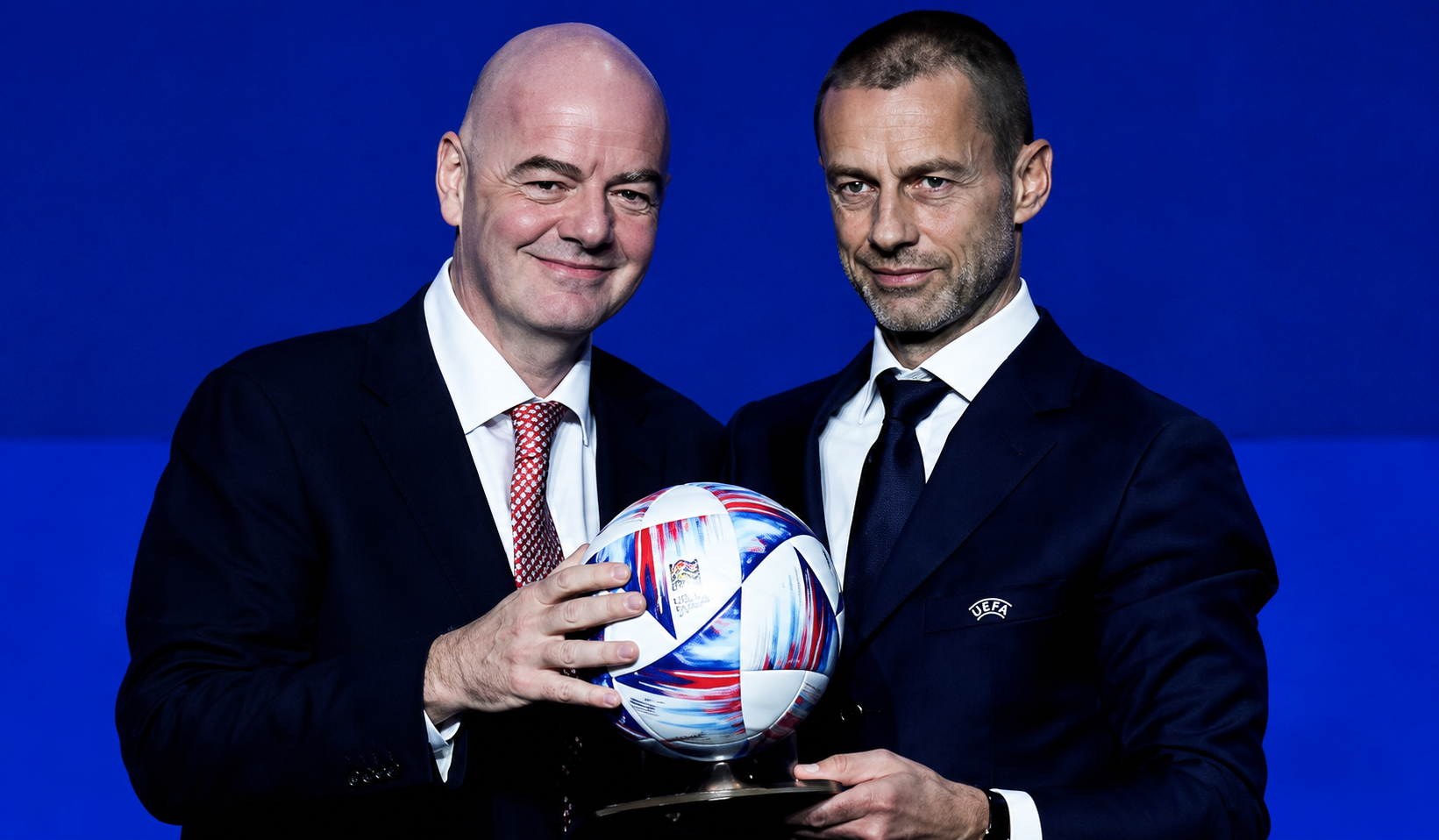
A growing dispute over the future of international football has erupted after 13 national football federations from Africa, the Caribbean and Asia issued a rare joint statement condemning comments attributed to UEFA President Aleksander Čeferin regarding the expanded 48-team FIFA World Cup.
The federations of Cape Verde, Curaçao, Uzbekistan, Congo, Haiti, Algeria, Tunisia, Morocco, Egypt, Ghana, Senegal, South Africa and Côte d’Ivoire expressed what they described as their “profound disappointment” over remarks suggesting that World Cup expansion would create “uninteresting” matches.
In their strongly worded statement, the federations rejected the characterization outright, arguing that every World Cup fixture carries significance for the nations involved and the millions of supporters who follow them.
“For our countries, there is no such thing as an unimportant World Cup match,” the statement said.
The controversy stems from a long-running debate over FIFA’s expansion of the World Cup from 32 to 48 teams beginning with the 2026 tournament. While FIFA President Gianni Infantino has consistently championed expansion as a tool for global football development, UEFA leadership has repeatedly expressed concerns that larger tournaments could dilute quality and weaken qualifying competitions.
Čeferin has been one of the most vocal critics of tournament expansion in recent years. In 2025, he publicly opposed proposals to further increase the World Cup to 64 teams, describing the idea as “a bad idea” for both the tournament and the qualifying process.
The federations argued that such criticism overlooks the realities faced by emerging football nations. They noted that qualification for countries such as Cape Verde, Curaçao and Uzbekistan represents historic national achievements, while nations like Haiti and Congo view their participation as the culmination of decades of effort and sacrifice.
The statement emphasized that football’s strength lies in its global reach rather than its concentration among traditional powers
“Football does not belong to a select group of nations. Its strength comes from its universality,” the federations declared.
The timing of the backlash is notable. The expanded tournament has already produced several eye-catching results, including Morocco’s draw against Brazil and Qatar’s dramatic point against Switzerland, outcomes supporters of expansion cite as evidence that newer participants can compete on the world stage.
For many federations outside Europe and South America, the expansion has created opportunities that were previously unavailable. Africa’s representation increased from five guaranteed places to nine, while Asia, CONCACAF and Oceania also received additional qualification slots under FIFA’s revised allocation system.
The statement concluded with a defense of merit-based qualification and a call for greater respect toward all participating nations.
“Every team qualified on merit. Every match matters.”
The dispute highlights a deeper philosophical divide within global football: whether the World Cup should primarily showcase the sport’s elite nations or serve as a platform for broader global representation. As the 2026 tournament unfolds, that debate appears far from settled.
Leave feedback about this