

By Paul Lucky Okoku
-
Qualification achieved. Questions invited.
-
Field dominance without conversion to goals invites trouble.
African football tournaments are rarely won by aesthetics or possession statistics. They are shaped by moments, judgment, and composure when physical and mental reserves are tested. The Super Eagles’ 3–2 victory over Tunisia at AFCON 2025 reinforced that reality.
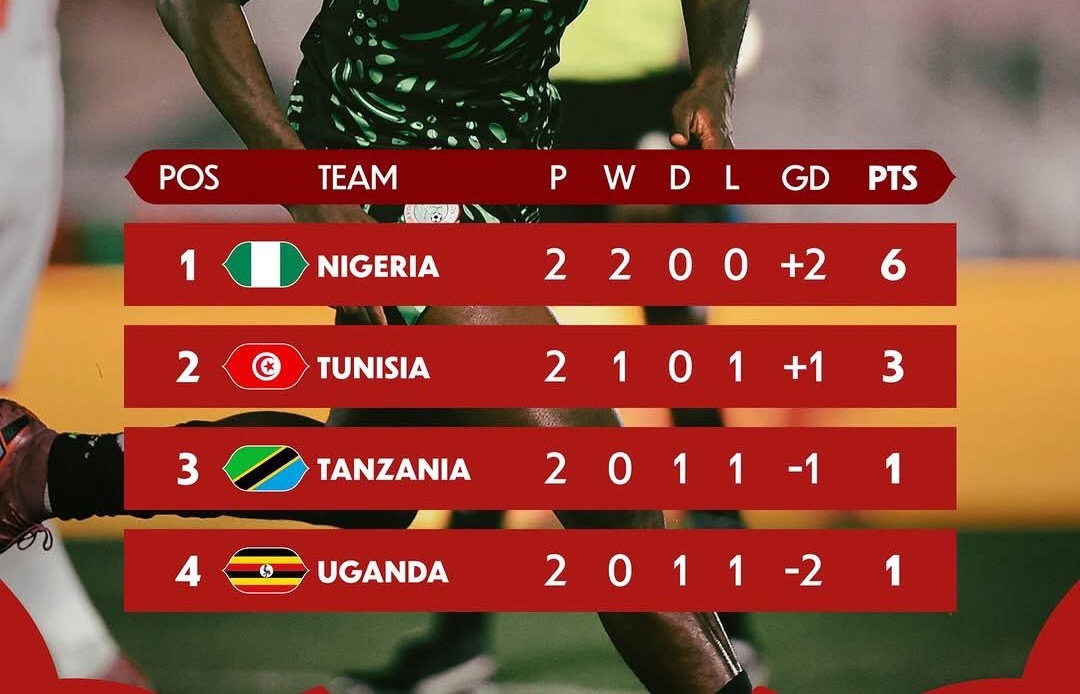
Nigeria did what was required from a standings perspective. The win ensured progression to the knockout round with a game remaining and placed the team in a strong position within the group. Yet the nature of the performance suggested that advancement alone should not be confused with readiness.
- Final Score: Nigeria 3–2 Tunisia
Nigeria Possession: 67%
Tunisia Possession: 33% - Nigeria Goals:
Victor Osimhen (44’)
Wilfred Ndidi (50’)
Ademola Lookman (67’) - Tunisia Goals:
Montassar Talbi (74’)
Ali Abdi (Penalty – 87’)
From kickoff, Nigeria asserted authority. The opening half was largely one-directional, with sustained pressure, intelligent ball circulation, and territorial superiority. The Super Eagles spent extended periods in advanced areas, repeatedly forcing Tunisia backward. The opportunity to put clear daylight between both sides arrived early—and often.
That separation never materialized.
A disallowed effort from Victor Osimhen in the opening quarter-hour set the tone for what followed: promising actions undone by fine margins. When the breakthrough finally arrived before the interval, Nigeria had already done enough to justify the advantage. The goal rewarded persistence rather than precision.
Tunisia offered little resistance In the first half during that spell. Nigeria dominated aerial contests, transitioned more quickly, and built attacks with purpose. Stanley Nwabali remained largely unoccupied, a spectator to the flow of play rather than a participant.
Still, football has a long memory. Opportunities ignored have a habit of resurfacing later, often at the least convenient moment.
Nigeria carried their initiative into the second half. A well-executed set piece doubled the lead, and when the third goal arrived shortly after the hour mark, the contest appeared settled. At that point, Nigeria had imposed their will through structure and tempo, particularly in midfield, where Alex Iwobi orchestrated proceedings with intelligence and calm. His reading of the game allowed Nigeria to control space and rhythm without unnecessary risk.
One sequence, however, stood apart. Osimhen’s aerial finish—timed to perfection and delivered with authority—captured the value of conviction in execution. It was a moment that reminded everyone why strikers of his profile command attention even when service is limited.
Then the contest shifted.
Tunisia’s response came not through sustained buildup but through belief. A goal midway through the second half altered the psychological balance, injecting urgency into their play and hesitation into Nigeria’s. The penalty that followed narrowed the margin further and introduced tension where there had been control.
From that moment on, Nigeria were no longer dictating terms. Fatigue crept in. Distances widened. Decision-making slowed. Tunisia pressed with purpose, and a late unmarked header nearly rewrote the outcome entirely.
Nigeria survived, but survival was not the plan.
There were positives beyond the scoreline. Osimhen’s overall demeanor reflected maturity—less frustration, more composure. Leadership is often revealed not in dominance but in response, and his performance suggested growth in that regard. His presence alone continues to reshape how opponents defend, drawing attention and creating opportunity for others.
As expected, post-match discussions turned quickly toward tactical decisions. That scrutiny is natural. It is also incomplete when it ignores execution. Once play begins, responsibility transfers from the technical area to the pitch. Missed chances, delayed reactions, and lapses in concentration are not schematic errors—they are human ones.
Nigeria led by three goals. That cushion should have been sufficient. When pressure mounted, some players retreated into themselves rather than asserting control. That shift was not strategic; it was psychological.
There is an American expression—“Monday Morning Quarterback”—used to describe judgments delivered after outcomes are known, stripped of the uncertainty and immediacy that shape real decisions. It does not dismiss opinion; it cautions against certainty born from hindsight.
Debate is essential to sport. So is context.
The same team under discussion scored three goals, won back-to-back matches, and secured early qualification. Both realities must coexist.
Looking ahead, the warning signs are clear. Tunisia demonstrated that Nigeria can be unsettled when intensity drops and efficiency fades. Uganda will not ignore that lesson. They will approach the next fixture prepared to test concentration, stamina, and resolve.
Nigeria remain well placed. But progress in tournaments of this nature demands more than control. It requires consistency when energy wanes and clarity when momentum shifts.
AFCON does not reward presence alone.
It rewards those who remain alert when control begins to loosen.
Nigeria advanced.
But the margin for error has been clearly outlined.
Reflections, In My Own Words — Championing Fairness, One Story at a Time. ✍️
— Paul Lucky Okoku
Former International | Football Analyst
Published Online
Former Nigerian Super Eagles International
AFCON 1984 Silver Medal Winner
Vice Captain, Flying Eagles of Nigeria (Class of 1983) — U-21 World Cup, Mexico
Leave feedback about this