

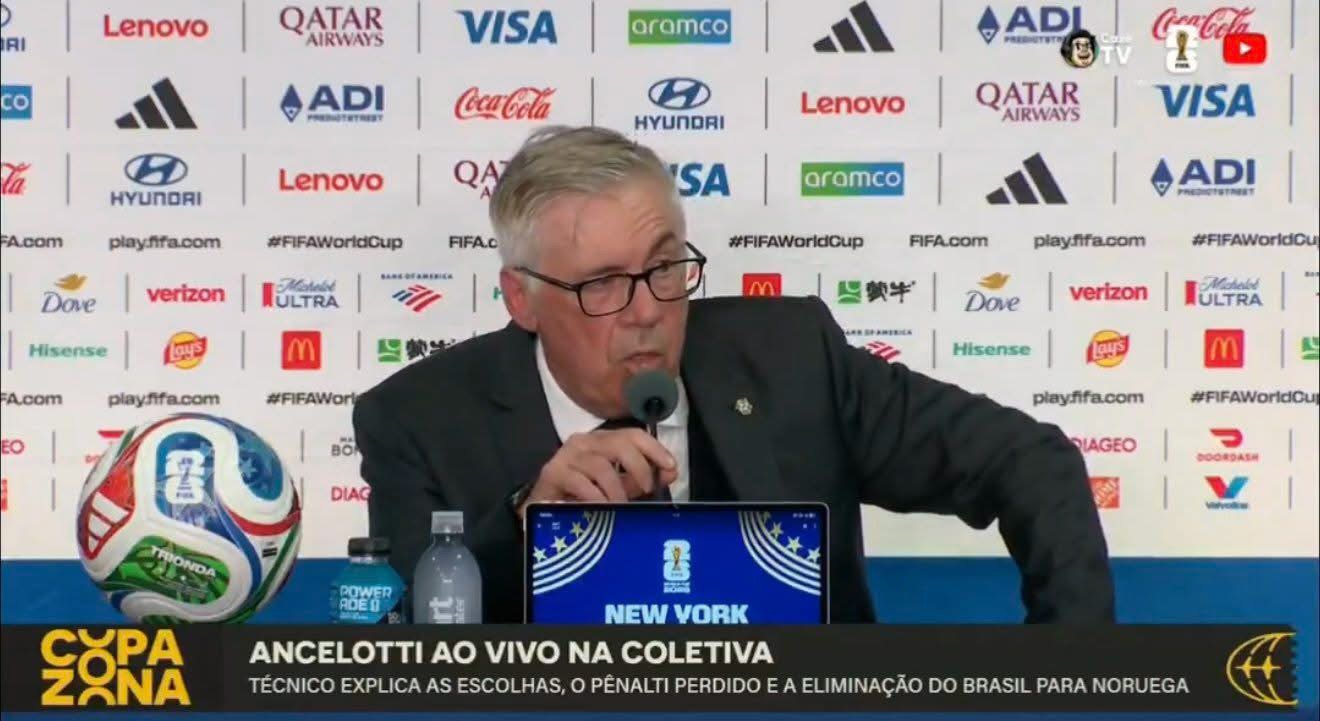
Brazil head coach Carlo Ancelotti has defended one of the most debated decisions of the Seleção’s heartbreaking FIFA World Cup exit, revealing that Vinícius Júnior was never first in line to take the first-half penalty against Norway because internal statistical analysis identified other players as stronger spot-kick options.
The decision came under intense scrutiny after Bruno Guimarães saw his penalty saved by Norway goalkeeper Ørjan Nyland in the opening stages of Brazil’s Round of 16 defeat. Norway went on to secure a famous 2-1 victory through a late Erling Haaland brace, condemning the five-time world champions to their earliest World Cup exit since 1990.
With Vinícius initially appearing to take responsibility before handing the ball to Guimarães, many supporters and pundits questioned why Brazil’s biggest attacking star had not stepped up in such a pivotal moment.
Ancelotti revealed after the match that the decision had been made long before kick-off and was based on extensive data gathered by Brazil’s coaching staff.
“Why didn’t Vini take the penalty? We did some stats and the best was Raphinha. From the players available, the best was Neymar, then Igor Thiago, then Bruno Guimarães, then Martinelli. We chose Bruno because we thought he was the best on the pitch.”
The Italian coach explained that Brazil’s designated penalty hierarchy is determined through a combination of training performances, conversion rates and analytical data rather than reputation alone. With Neymar and Raphinha beginning the match on the bench, Guimarães became the highest-ranked penalty taker among the players on the field when Brazil were awarded the spot-kick.
Ancelotti’s explanation was later reinforced by Vinícius himself, who insisted the decision came directly from the coaching staff and denied suggestions that he had avoided taking responsibility.
“Ancelotti decides before the match who will take the penalties, and he chose Bruno. I’ve never shied away from responsibility. I take penalties at Real Madrid when necessary, and for Brazil as well.”
The revelation surprised many observers given Vinícius’ status as Brazil’s attacking leader. However, statistics from his professional career help explain Ancelotti’s reasoning. While the Real Madrid winger has developed into one of the world’s most devastating forwards, penalties have not been considered the strongest aspect of his game, converting 13 of his 19 career spot-kicks before the tournament—a success rate of approximately 68 percent.
Instead, the responsibility fell to Guimarães, whose low effort was comfortably saved by Nyland. It marked Brazil’s first missed penalty during normal play at a FIFA World Cup since 1986 and immediately became one of the defining moments of their elimination.
Ancelotti refused to blame the midfielder for the miss, maintaining that the decision remained the correct one based on the information available before the match.
The veteran manager also dismissed suggestions that the penalty alone determined Brazil’s fate, arguing that his side created opportunities throughout the contest but struggled to impose themselves against a disciplined Norwegian defence before Haaland struck twice late in the game.
Nevertheless, the penalty decision has become one of the tournament’s biggest talking points in Brazil. Critics questioned whether data should outweigh instinct in high-pressure moments, while others argued that a player of Vinícius’ stature should have assumed responsibility regardless of pre-match planning.
For Ancelotti, however, the choice was never based on emotion.
It was the product of months of preparation, statistical analysis and training-ground evidence. Although the outcome ultimately proved painful, the Brazil coach made clear he would not distance himself from a decision he believed was justified.
The controversy is likely to remain part of the post-mortem into Brazil’s disappointing World Cup campaign, but Ancelotti’s explanation has at least clarified one of the tournament’s most debated moments: Vinícius Júnior did not decline the penalty—he simply followed the plan his coach had already put in place.
Leave feedback about this