

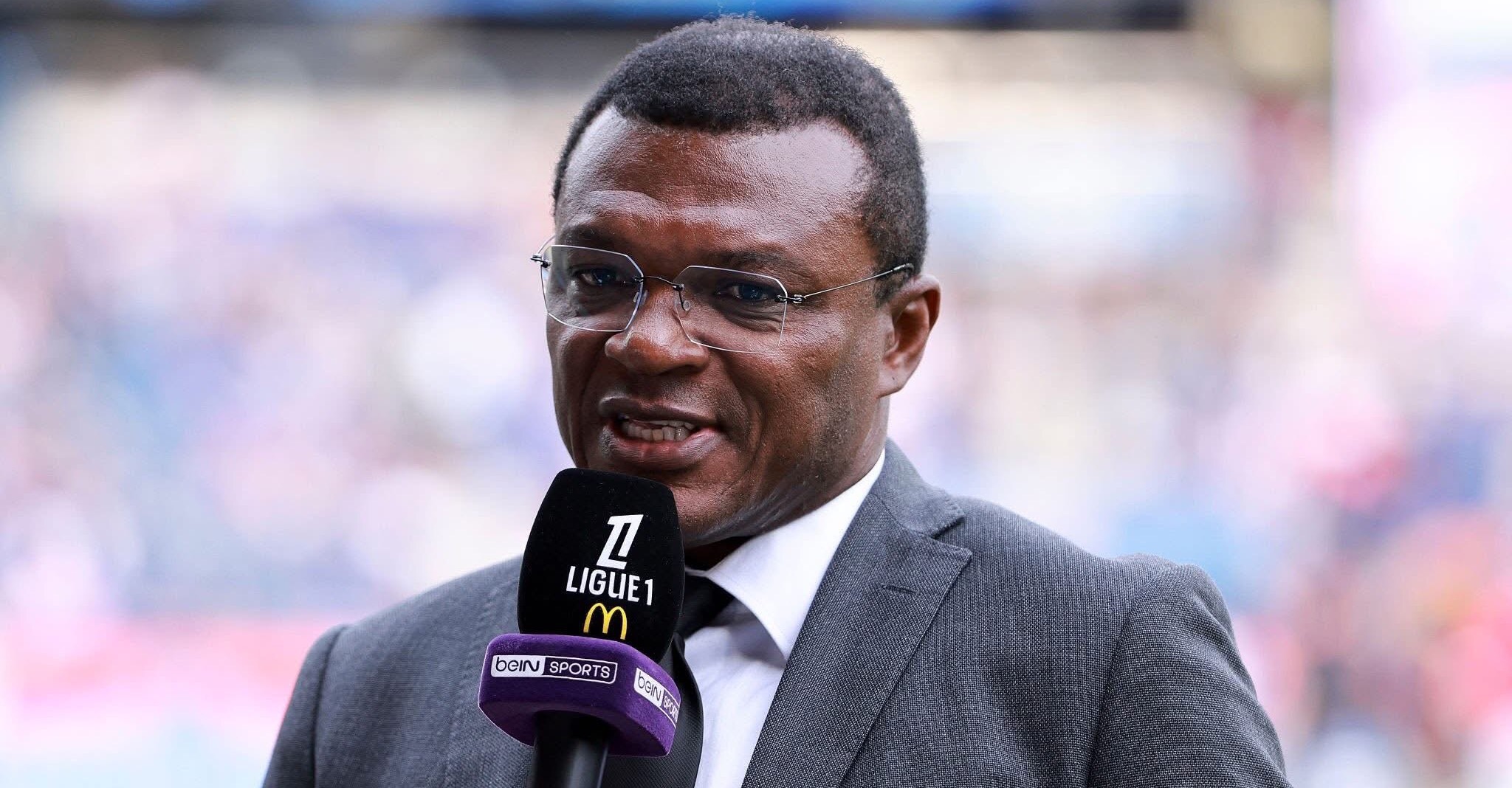
Former France international Marcel Desailly has revisited the circumstances that led him to represent France rather than Ghana, explaining that his decision was heavily influenced by the football system in which he was developing as a young player.
Desailly, who was born in Accra, Ghana, on September 7, 1968, moved to France when he was four years old and began his football development there. The French Football Federation records him as earning 116 senior caps for Les Bleus, winning the 1998 FIFA World Cup and UEFA Euro 2000.
Speaking about his international choice, Desailly explained: “I chose French because if I chose Ghana, I wouldn’t play anymore in my team. I couldn’t begin professional.”
The comments reflect the football environment Desailly encountered as a teenager. He had already entered the French football system and was progressing towards a professional career when the question of international representation arose.
In an earlier interview with FourFourTwo, Desailly explained that he had been playing within the French system from the age of 13 and said he had never seriously considered representing Ghana at senior level.
He added that his decision to represent France never meant abandoning his Ghanaian identity. “Sure that I play for the French national team, but I’m Ghanaian, I’m born in Ghana. I have all my family here.”
That connection to Ghana has remained an important part of Desailly’s personal story. His birthplace is officially recorded as Accra, while his family has maintained strong links to the Ghanaian capital. Le Parisien previously documented his emotional return to Accra and his meeting with his paternal grandmother in 1989, describing the encounter as an unforgettable moment for the former defender.
‘There Was No Choice to Even Consider’
Desailly has previously offered a slightly different but complementary explanation of his international decision.
In an interview with Joy Sports reported by Pulse Ghana, he said he had already been embedded in the French football structure from a young age and that, by the time he became eligible for senior international football, the opportunity to represent France had naturally emerged. “I was already in the [France] system. I got professional from 18/19 years of age, and I got my opportunity to join the French national team, so there was no choice to even consider.”
The distinction is important: Desailly’s more recent comments describe the career implications he perceived at the time, while his earlier account emphasises that his football development was already firmly rooted in France.
A French World Champion With Ghanaian Roots
The choice ultimately produced one of the most decorated careers in French football.
Desailly made his France debut against Sweden in August 1993 and went on to become a key member of the team that won the 1998 World Cup on home soil. Two years later, he was part of France’s European Championship-winning side. The FFF credits him with 116 appearances for the national team.
At club level, he won the European Cup with Marseille in 1993 and again with AC Milan in 1994, before continuing his career at Chelsea and other clubs.
Yet the success he achieved wearing France’s colours did not erase his connection to Ghana.
That duality is central to Desailly’s story: France became the country in which his football career was developed and where he achieved international glory, while Ghana remained the country of his birth and an enduring part of his identity.
His experience also illustrates a broader issue in African football: players with African heritage who develop in European football systems can face complicated decisions when international opportunities emerge.
For Desailly, the decision eventually produced a World Cup-winning career with France. But, decades later, his message remains clear — representing France did not make him any less Ghanaian.
Leave feedback about this