

By Kazeem Ajibola Shoyebo
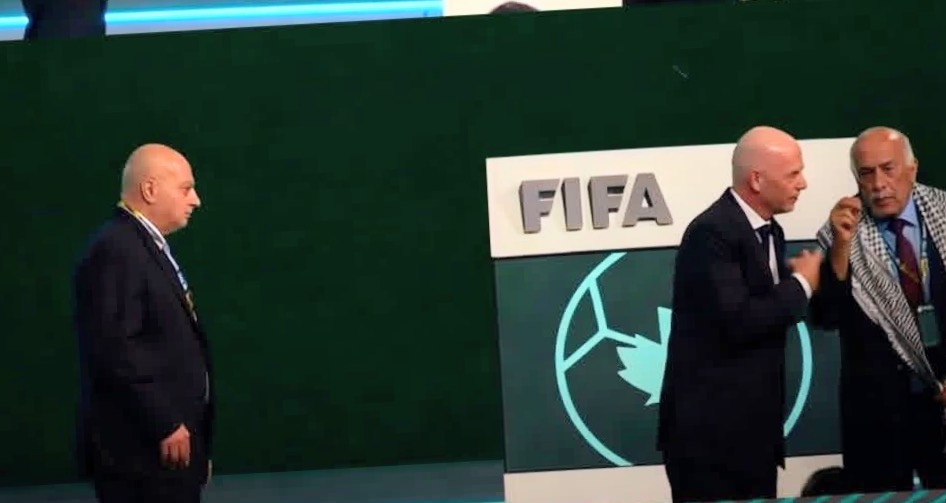
An attempted handshake at the FIFA Congress has laid bare the enduring fault lines between Israel and Palestine, and the growing limitations of FIFA in managing politically charged disputes.
When FIFA president Gianni Infantino invited Jibril Rajoub and Basim Sheikh Suliman to stand together, the moment was clearly designed as a visual statement of unity. Instead, it became a public rejection.
Rajoub refused outright, later stating he could not engage with a representative of a government whose policies he opposes, turning what was meant to be diplomacy into a stark political statement.
At the heart of the tension is a long-running dispute over Israeli clubs based in settlements in occupied territories. The Palestine Football Association argues these teams violate FIFA statutes, which prohibit clubs from playing in another association’s territory without consent.
Despite years of deliberation, FIFA has stopped short of decisive action, prompting the Palestinian side to escalate the matter to the Court of Arbitration for Sport.
Infantino’s intervention highlights a recurring challenge: the reliance on symbolic gestures in situations that demand structural решения. While FIFA promotes unity and inclusivity, critics argue that avoiding firm rulings risks undermining its credibility.
The failed photo opportunity underscored that gestures alone cannot bridge deeply rooted political divides—especially when one side believes its grievances remain unaddressed.
The episode also reflects broader pressures on FIFA as it navigates geopolitical tensions among its members. With global conflicts increasingly intersecting with sport, the organisation faces growing expectations to take clearer positions.
At the same time, any decisive action risks alienating member associations and complicating FIFA’s role as a neutral governing body.
What unfolded at the Congress was more than a дипломатический misstep, it was a reminder of the complex realities shaping modern football governance.
The image that never materialised may ultimately be more telling than any staged photograph: a visible demonstration that, in global football, unity cannot be manufactured without addressing the deeper issues beneath the surface.
Leave feedback about this