

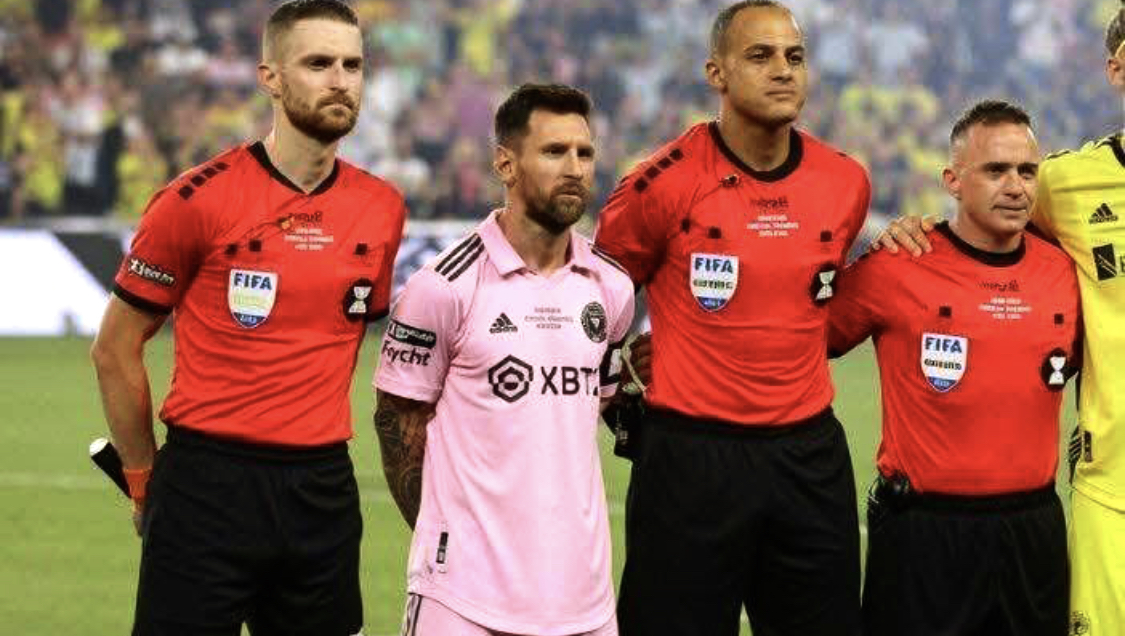
The appointment of American referee Ismail Elfath to officiate Wednesday’s FIFA World Cup semi-final between England and Argentina has ignited widespread debate, with British media headlines and social media speculation fuelling conspiracy theories that FIFA is favouring Lionel Messi and the defending world champions.
The controversy intensified after the Daily Mail published a headline suggesting Messi had been handed his “favourite referee” for one of the biggest matches of the tournament, prompting fresh scrutiny of FIFA’s refereeing appointments ahead of the blockbuster clash.
At the center of the discussion is Elfath’s previous involvement in matches featuring Messi.
The Moroccan-born American served as the fourth official during Argentina’s dramatic victory over France in the 2022 FIFA World Cup final and has since refereed four Inter Miami matches involving Messi, with the MLS club winning all four. Messi also scored in each of those matches, including the 2023 Leagues Cup final triumph.
Those statistics have led some supporters—particularly on social media—to question whether the appointment unintentionally benefits Argentina. However, there is no verified evidence that Elfath’s appointment reflects bias, favoritism or manipulation by FIFA.
Football analysts have cautioned that the referee’s previous record in Messi matches is largely circumstantial. Inter Miami were favorites in several of those games, while Elfath’s role as fourth official in the 2022 World Cup final did not involve making on-field decisions.
FIFA selected Elfath based on his extensive international experience and strong performances throughout the tournament. The 44-year-old has already officiated multiple matches at the 2026 World Cup and will become part of the first all-American refereeing team to handle a men’s World Cup semi-final, alongside assistant referees Corey Parker and Kyle Atkins.
The appointment also follows FIFA’s long-standing neutrality principles. English referees Michael Oliver and Anthony Taylor were automatically ruled out after England reached the semi-finals, while Argentine referee Facundo Tello was similarly unavailable because officials cannot oversee matches involving their own national teams.
Despite the online speculation, neither FIFA nor its refereeing department has indicated that previous matches involving Messi played any role in Elfath’s selection. Instead, appointments are made by FIFA’s Referees Committee based on performance evaluations, fitness, consistency and neutrality throughout the competition.
The debate nevertheless underscores the intense scrutiny surrounding one of international football’s greatest rivalries. England and Argentina have produced some of the World Cup’s most memorable encounters, from the 1966 quarter-final to Diego Maradona’s “Hand of God” and “Goal of the Century” in 1986, ensuring every major decision in Wednesday’s semi-final will be examined in microscopic detail.
With Lionel Messi chasing another World Cup final and England seeking their first appearance in the tournament’s showpiece since 1966, the spotlight will be on much more than the players.
For Elfath, the challenge is straightforward but enormous: deliver an impartial, composed performance that allows one of football’s biggest occasions to be decided by the players rather than the whistle.
While conspiracy theories have gained traction online and in some media coverage, no verified evidence has emerged to support claims that the tournament is rigged or that FIFA has manipulated referee appointments in Argentina’s favor. The focus now shifts to whether Elfath can justify FIFA’s confidence when the world’s attention turns to Atlanta.
Leave feedback about this