

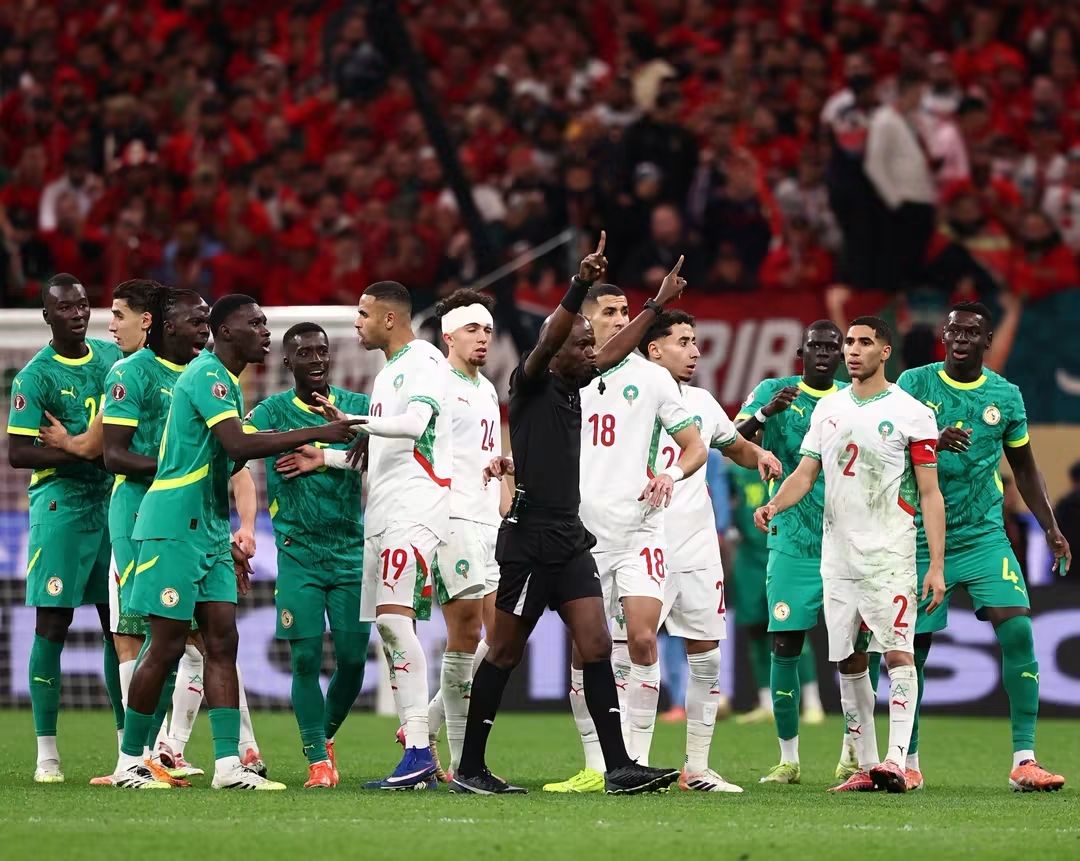
The battle for the 2025 Africa Cup of Nations title between Senegal and Morocco will reach a decisive moment on Tuesday, November 24, when the Court of Arbitration for Sport (CAS) delivers its ruling on Senegal’s appeal against the controversial decision that stripped the West African nation of the continental crown.
The announcement, confirmed by CAS in a procedural update on Monday, November 23, means the football governing bodies of Senegal, Morocco and Africa will finally receive the outcome of a legal dispute that has remained unresolved since CAF overturned the original result of the January final.
Senegal’s challenge centres on the decision of the CAF Appeal Board, which declared the Teranga Lions to have forfeited the final and awarded Morocco a 3-0 victory under Article 84 of the AFCON regulations.
The controversy originated during the January 18 final in Rabat, where Senegal initially defeated the tournament hosts 1-0 after extra time.
The match took a dramatic turn late in regulation time when Congolese referee Jean-Jacques Ndala awarded Morocco a penalty following a VAR intervention.
Senegal’s players protested the decision and temporarily abandoned the field of play following instructions from head coach Pape Thiaw.
After approximately 14 minutes, the players returned, and the match continued. Morocco’s Brahim Diaz failed to convert the resulting penalty before Pape Gueye scored the winning goal for Senegal in extra time.
Despite the conclusion of the match, the dispute continued beyond the final whistle.
On March 17, 2026, CAF’s Appeal Board overturned the original result, ruling that Senegal had breached Articles 82 and 84 of the competition regulations by leaving the pitch without the referee’s authorisation.
The decision recognised Morocco as the winners through a 3-0 administrative victory, effectively removing Senegal’s championship status.
Senegal subsequently approached CAS on March 25, asking the international sports arbitration body to set aside CAF’s decision and restore the original result.
The legal arguments and CAS proceedings
The central issue before CAS concerns the interpretation and application of the AFCON regulations, particularly the provisions governing teams that leave the field of play before a match has been completed.
Senegal’s position is that the referee’s decisions are final and that the match was allowed to continue to its conclusion after the players returned to the field. The arguments of all three parties were presented during a hearing in Lausanne on October 8.
The arbitration panel is presided over by French sports law expert Gérald Simon, with Italian international law professor Luigi Fumagalli and Hamburg-based lawyer and University of Zurich professor Ulrich Haas serving as fellow arbitrators.
CAS had initially indicated that a decision could follow shortly after the hearing. However, the court subsequently opted to issue a comprehensive arbitral award, including its legal reasoning, a process that required additional weeks.
On October 19, CAS confirmed that the award was expected before the end of November 2026.
Monday’s announcement has now provided the definitive date.
What is at stake?
Tuesday’s ruling will determine whether CAF’s decision to award Morocco the title survives Senegal’s legal challenge or whether the original 1-0 result is restored.
A successful Senegalese appeal would overturn the administrative decision that recognised Morocco as champions, while a dismissal of the appeal would leave CAF’s 3-0 ruling in place.
The implications extend beyond the two national teams, as the case also raises important questions about the interpretation of competition regulations, the authority of match officials and the disciplinary powers of football governing bodies.
CAS has clarified that its awards carry the value of arbitral judgments and may be enforced through sports federations or state courts, depending on the circumstances.
With the three parties already notified, attention is now firmly fixed on Lausanne, where the outcome of the appeal will determine the next chapter in one of African football’s most controversial title disputes.
CAS has also confirmed that it will not provide further media communication on the decision until its formal announcement.
Leave feedback about this