

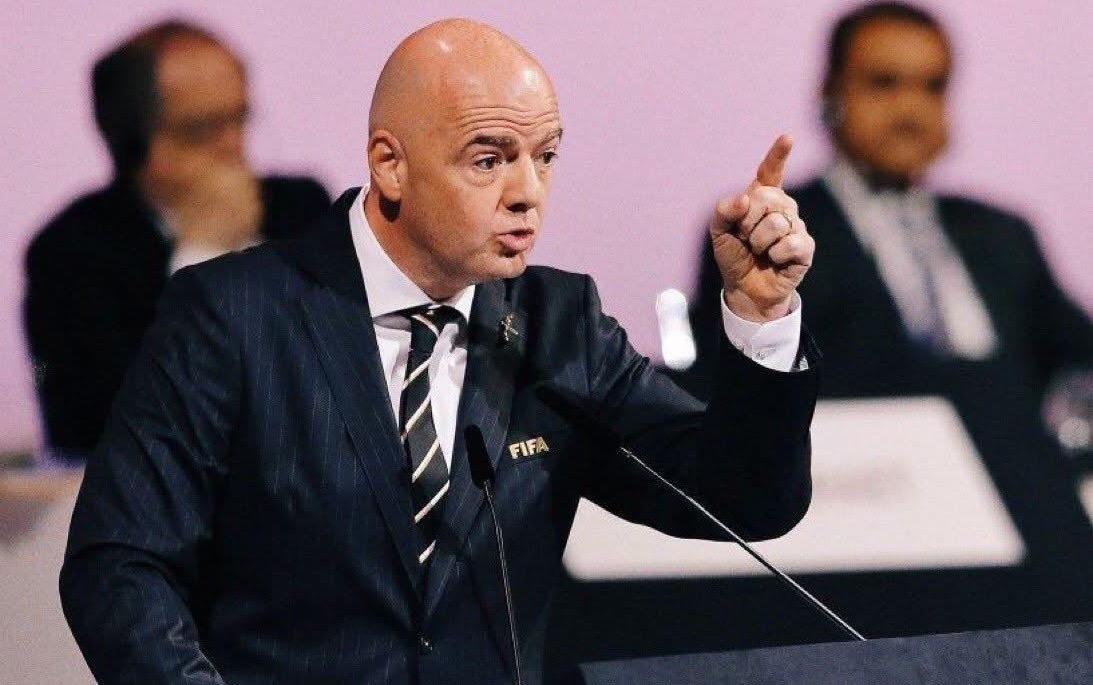
European football’s governing body UEFA has launched an extraordinary attack on FIFA President Gianni Infantino, accusing world football’s governing body of crossing a dangerous line after reports revealed plans to sell minority stakes in the commercial rights of the FIFA World Cup to private investors.
The strongly worded statement, issued in response to an investigative report by The Times, marks one of the most serious public confrontations between UEFA and FIFA in recent years and raises fresh questions over the future governance of the world’s most prestigious football tournament.
According to The Times, FIFA is exploring the creation of a new commercial entity—known as FIFA Forward Enterprise (FFE)—that would consolidate the commercial rights of the FIFA World Cup, FIFA Women’s World Cup, Club World Cup and other competitions. The proposal reportedly values the new company at approximately $20 billion, with FIFA seeking to raise up to $4.2 billion by selling minority, non-controlling stakes to private investors led by Thrive Capital, the investment firm founded by Joshua Kushner.
Although FIFA has stressed that it would retain majority ownership and exclusive authority over football governance, competitions, regulations and the international match calendar, UEFA believes the proposal represents a fundamental shift in the ownership and stewardship of the global game.
Responding to the reports, UEFA issued one of its strongest statements in recent memory
“This crosses a line that football’s governing institutions should never cross. UEFA takes it extremely seriously. So should every National Football Association. So should every stakeholder: leagues, clubs, players, supporters, governments and everyone who cares about the future of the game.
The soul and governance of football are not assets to trade—especially with zero transparency as to who gains financially.
None of us are the owners of football. It is not FIFA’s to sell.”
UEFA’s criticism centres on transparency and governance rather than the search for new commercial revenue. The European governing body argues that transforming football’s flagship competitions into investment assets risks creating conflicts between sporting integrity and investor expectations, particularly if private shareholders begin demanding greater influence over tournament expansion, scheduling or commercial strategy.
The proposal has also drawn criticism because of the reported involvement of investors connected to the Kushner family, whose close relationship with FIFA President Gianni Infantino and U.S. President Donald Trump has already generated political debate throughout the 2026 FIFA World Cup.
FIFA, however, has rejected suggestions that football governance would be compromised.
In a statement cited by Reuters and other international media, FIFA said the proposed structure would ensure it retained sole control through majority board representation and exclusive authority over football governance, competitions, the international match calendar and all sporting decisions. FIFA described the proposal as part of a broader effort to generate additional investment for football development worldwide while maintaining democratic oversight through its 211 member associations.
Under the reported framework, national associations would have the option of participating in the new commercial venture, with projections suggesting they could each receive a one-time financial distribution worth around $20 million if the proposal is ultimately approved. Any final decision would require the backing of FIFA’s member associations.
UEFA’s intervention is significant because it signals growing resistance from Europe’s football leadership to what it sees as an increasingly commercial and centralised model of governance under Infantino. The dispute follows months of tension between the two organisations over several high-profile issues, including FIFA’s handling of disciplinary matters during the 2026 World Cup and broader concerns about political influence within the sport.
While FIFA insists the proposal remains at a consultation stage, UEFA’s statement suggests the debate has moved beyond financial strategy to become a battle over who should control football’s future.
For UEFA, the issue is not simply whether new investors can generate more revenue.
It is whether football’s biggest competitions should ever become commercial assets whose value is influenced by private investment—an idea the European governing body believes threatens the very principles on which the global game has been built.
Leave feedback about this