


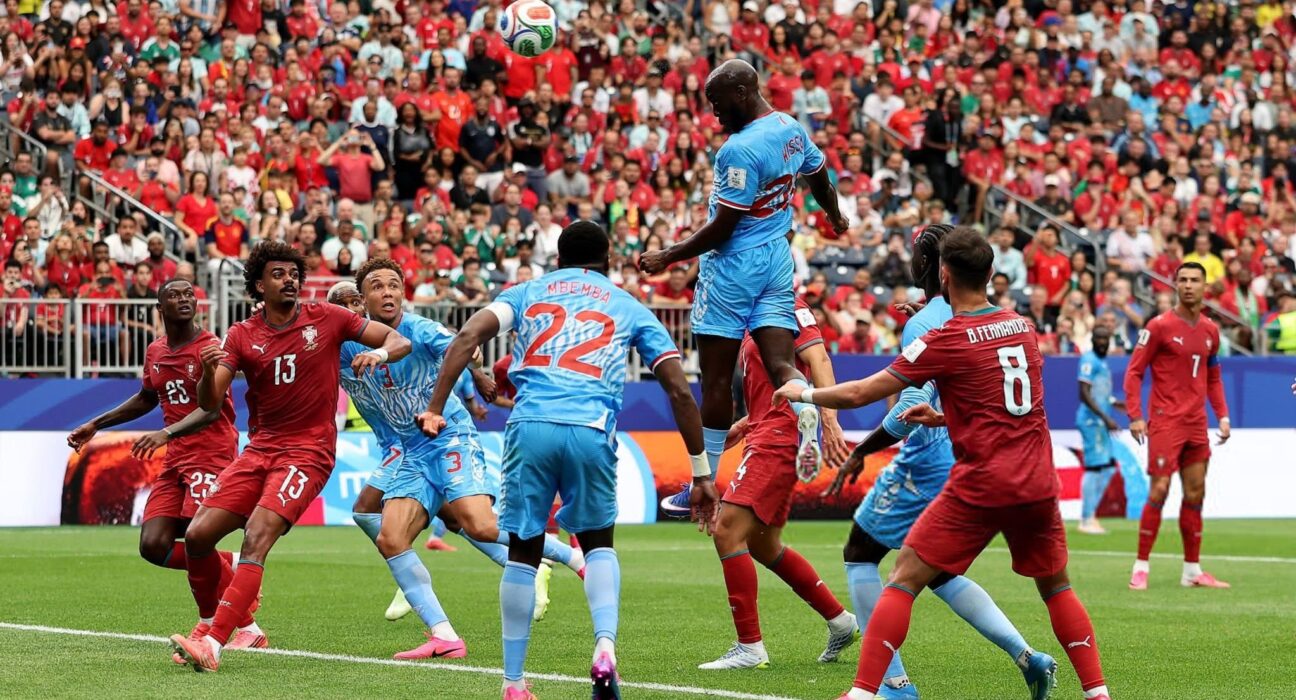
The Democratic Republic of Congo produced one of the most memorable moments of the 2026 FIFA World Cup so far, holding Portugal to a 1-1 draw on Wednesday and securing the nation’s first-ever point in World Cup history.
What had been expected to be a comfortable opening Group K victory for Roberto Martinez’s star-studded Portugal instead became a celebration of Congolese resilience as Yoane Wissa’s historic first-half equalizer cancelled out João Neves’ early opener before the Leopards held firm through a tense second half.
Portugal appeared on course for victory almost immediately when 21-year-old João Neves headed home in the sixth minute after an excellent delivery from Pedro Neto. The goal made the Paris Saint-Germain midfielder the third-youngest Portuguese player ever to score at a FIFA World Cup, behind only Cristiano Ronaldo and Gonçalo Ramos.
Youngest Portugal goalscorers in FIFA World Cup history:
Portugal dominated possession during much of the opening half and looked capable of extending their lead. However, Sébastien Desabre’s side gradually settled into the contest, defending with discipline and growing increasingly dangerous from set pieces and counterattacks.
Then came a moment that will forever occupy a special place in Congolese football history.
Deep into first-half stoppage time, Wissa met a cleverly-worked corner kick with a powerful back-post header that flew beyond Diogo Costa. The goal was not merely an equalizer, it was the first World Cup goal ever scored by DR Congo.
The significance was enormous. DR Congo, competing in only their second World Cup and first since appearing as Zaire in 1974, had waited 52 years and three days from their tournament debut to finally celebrate a goal on football’s biggest stage. Only Bolivia endured a longer wait before scoring their first World Cup goal.
Wissa’s strike sparked emotional celebrations among players and supporters alike, including the famous “Fimbu” dance, a national celebration inspired by a popular Congolese song that has become closely associated with the national team.
The Brentford-born forward also entered another unique chapter of World Cup history. Born in France before choosing to represent DR Congo internationally, Wissa became the latest French-born player to score for a foreign national team at a World Cup.
That distinguished list includes Gonzalo Higuaín for Argentina, André Ayew for Ghana, Raphaël Guerreiro for Portugal, Kalidou Koulibaly, Boulaye Dia, M’Baye Niang and Ibrahim Mbaye for Senegal, Sofiane Feghouli and Yacine Brahimi for Algeria, Sofiane Boufal and Khalid Boutaïb for Morocco, Wahbi Khazri and Dylan Bronn for Tunisia, Jean-Charles Castelletto for Cameroon, and Jacques Fatton for Switzerland.
Portugal pushed hard after the break. Cristiano Ronaldo, making his historic sixth World Cup appearance, searched for a breakthrough while Bruno Fernandes and Bernardo Silva attempted to unlock the Congolese defense. Yet clear chances proved surprisingly scarce.
Instead, it was DR Congo who arguably looked more dangerous in transition. Wissa, Cedric Bakambu and their supporting cast repeatedly threatened to punish Portugal on the counterattack as confidence grew with every passing minute.
The final whistle triggered scenes of jubilation among the Congolese players. After decades of waiting, they had finally scored at a World Cup and earned their first point in tournament history.
For Portugal, the draw represented an unexpected setback in a group that also includes Colombia and Uzbekistan. For DR Congo, however, it felt like a victory—a result that instantly became one of the proudest moments in the nation’s football history.