


-
When Talent Travels, Football Evolves
By Paul Lucky Okoku
The modern game is no longer defined by where a player is born, but by where a nation chooses to build its football identity.
Football’s future belongs not to geography, but to organization, opportunity, and vision.
“The question is no longer whether Africa is catching up. The question is whether football has outgrown the old definitions of nationality.”
When talent crosses borders, football does not lose its identity—it expands it.
There was a time when seeing Brazil on the fixture list was enough to intimidate opponents before kickoff.
Brazil represented flair, confidence, and football excellence. For many of us who grew up with the game, Brazil was football.
Yet football evolves.
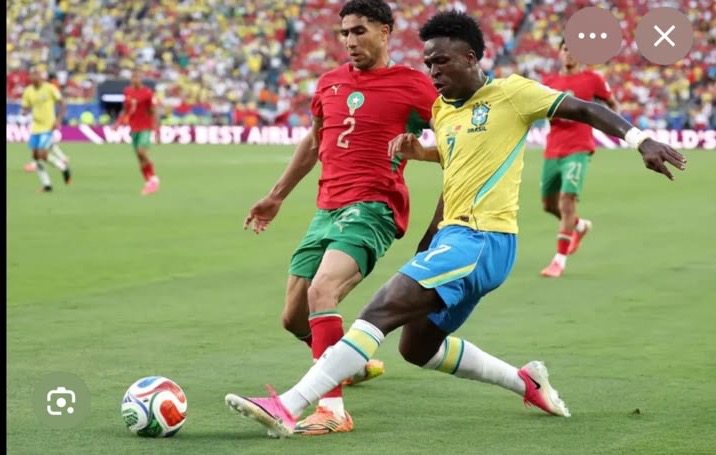
Morocco’s performance against Brazil at the FIFA World Cup was another reminder that the football world has changed.
Modern football is no longer a contest between continents. It is increasingly a contest between football systems, talent development pathways, and national vision.
Morocco’s Performance Was No Accident
For much of the opening period, Morocco controlled the rhythm of the match.
They pressed intelligently, moved the ball with confidence, and attacked with purpose. Their positioning was organized, their transitions were sharp, and their tactical discipline was evident.
Brazil still created opportunities and possessed moments of quality, but Morocco often looked like the more structured team.
And in modern football, organization frequently defeats reputation.
The goal itself reflected preparation and belief: a defensive error, a quick reaction, a burst of pace, and a composed finish over the goalkeeper.
Morocco earned that moment.
The Mistake We Must Avoid
Too often, when an African team performs well, the conversation focuses on what the traditional power failed to do.
That misses the point.
Morocco did not succeed because Brazil failed.
Morocco succeeded because Morocco executed its game plan effectively.
African success should not always be explained through the lens of European or South American decline. It should be recognized as the product of investment, coaching, planning, and player development.
Is Africa Catching Up?
The answer is yes—but perhaps not in the way many people imagine.
The global football landscape has changed.
Coaching knowledge, sports science, tactical education, and performance analysis are now shared across continents. The information gap that once existed between traditional powers and emerging nations has narrowed significantly.
As knowledge spreads, talent becomes more competitive.
That is exactly what we are witnessing today.
The New Reality of National Identity
Many Moroccan players were born or developed outside Morocco. Some came through academies in France, Belgium, Spain, and the Netherlands.
The same reality exists in Nigeria, Senegal, Ghana, Algeria, and several other African nations.
This raises an interesting question:
Are we witnessing African success, European development success, or both?
The honest answer is both.
Modern football development is global. A player may be born in Europe, trained in Europe, yet remain deeply connected to his family’s country of origin.
Identity today is more complex than geography alone.
The Domestic Development Question
Critics argue that reliance on foreign-born players exposes weaknesses in domestic football structures.
There is merit in that concern.
Strong domestic leagues, academies, and grassroots programs remain essential.
However, national identity cannot be reduced to birthplace alone.
Commitment matters.
Representation matters.
Choice matters.
When a player willingly chooses to represent a nation and carry its expectations, that commitment deserves respect.
What Morocco Is Teaching the World
Morocco’s rise is not accidental.
It is the result of combining:
- Strategic football investment
- Modern infrastructure
- International development pathways
- Strong federation leadership
- A clear football identity
That combination has transformed Morocco into one of the most respected national teams in world football.
Policy, planning, and patience are producing results.
Brazil’s Challenge
Brazil remains one of football’s great powers.
Its history commands admiration.
Its badge commands respect.
But history alone no longer wins matches.
Today’s opponents are better organized, better prepared, and far less intimidated.
The rest of the football world has studied Brazil for decades.
Many have learned.
Some have caught up.
A Memory From Rabat
Watching Morocco against Brazil also brought back memories of my own football journey.
In August 1983, I was part of a Nigerian national team that traveled to Rabat* to face *Morocco* in a pivotal qualifier for the *1984 Africa Cup of Nations (AFCON) in Ivory Coast. Even then, Morocco was one of Africa’s most respected footballing nations. Playing them on their home soil was intimidating. Their supporters were passionate, their players were technically gifted, and their football culture was already deeply rooted.
Our team, led by Stephen Keshi and coached by the late Chief Adegboye Onigbinde. eventually prevailed in a dramatic penalty shootout. The late Peter Rufai produced crucial saves that secured victory for Nigeria and helped send us to the 1984 AFCON. I was one of several Flying Eagles players elevated to the senior national team, giving us the rare privilege of representing both the Flying Eagles and the Green Eagles during the same period.
Just two months earlier, I had returned from the FIFA World Youth Championship in Mexico, where I served as Vice-Captain of the Flying Eagles There, I faced Brazil and talented young players such as Bebeto and Dunga, who would later become global football icons. In the same tournament, I also played against the Netherlands and a rising star named Marco van Basten, who would go on to become one of the greatest forwards in football history.
Life has a way of coming full circle.
Looking back today, it is both humbling and gratifying to analyze matches involving football nations and players whose journeys intersected with mine more than four decades ago.
That experience reminds me that Morocco’s emergence on the global stage is not a sudden phenomenon. The foundations were laid many years ago, and what we are witnessing today is the result of decades of football culture, investment, development, and belief.
The Match Brief
The final score was Brazil 1–1 Morocco, but the result told only part of the story.
Morocco stunned many observers by matching Brazil stride for stride and, for long stretches, looking like the better organized team.
Led by Achraf Hakimi, Morocco combined defensive discipline with intelligent attacking transitions. Brazil, meanwhile, relied heavily on the threat of Vinícius Júnior and its attacking quality to remain dangerous.
Morocco’s goal came after a costly defensive mistake by Brazil, allowing the Moroccan attacker to race through and finish with a composed chip over the goalkeeper. Brazil eventually found an equalizer, but the *1–1 draw* reflected the balance of play more accurately than a Brazilian victory would have.
By the final whistle, the result felt less like an upset and more like a fair reward for Morocco’s preparation, organization, and belief.
The Bigger Picture
The most important lesson from this match is not that football has become equal.
It has not.
But it has become more balanced.
Traditional powers remain strong, yet emerging nations are stronger than ever before.
Morocco’s performance against Brazil was another reminder that football’s center of gravity continues to shift.
The game belongs to more nations, more cultures, and more ideas than at any point in its history.
That should be celebrated, not feared.
Football was once divided by geography. Today it is connected by opportunity. The nations that recognize that reality first will shape the future of the game.
Share Note
*If this article added value or offered perspective, you are welcome to share it with others. Football conversations become richer when they are informed by balance, context, and respect for differing viewpoints.*
Paul Lucky Okoku
Former Nigerian International Footballer | Football Analyst
Published Online
*Former Nigerian Super Eagles International*
* CAF Africa Cup of Nations (AFCON) 1984 — Silver Medalist
* WAFU Nations Cup 1983 — Gold Medalist
* CAF Tessema Cup (U-21) 1983 — Gold Medalist
* FIFA U-20 World Cup, Mexico 1983 — Vice-Captain, Flying Eagles of Nigeria