

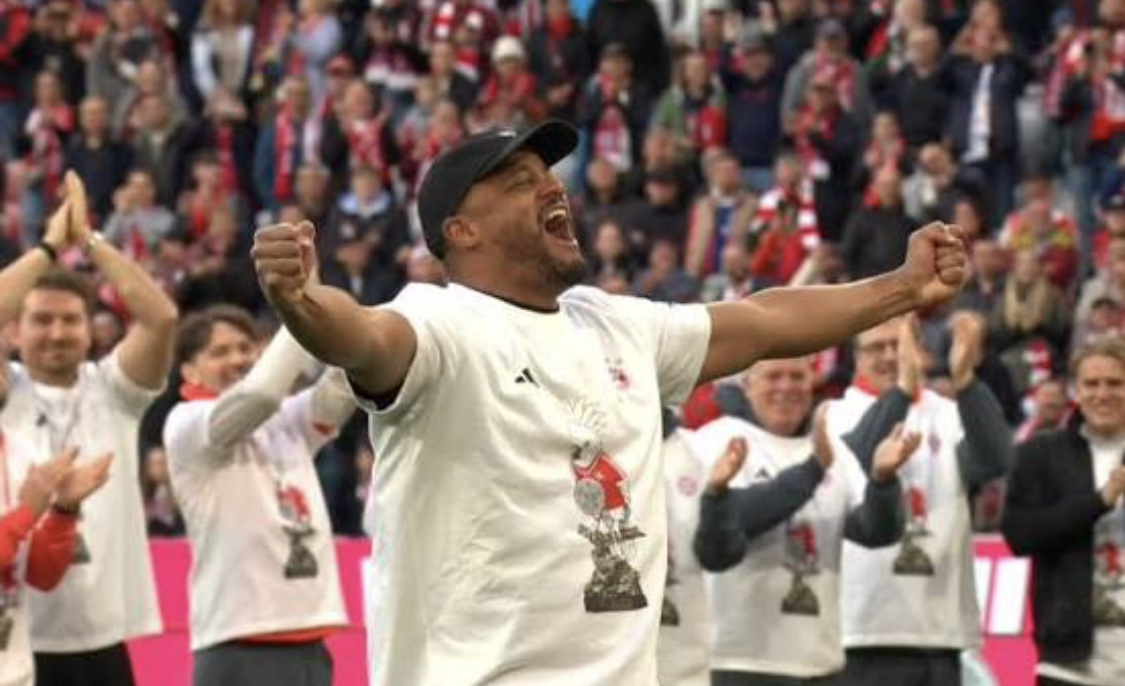
By Paul Lucky Okoku
When preparation meets belief, criticism becomes background noise and history becomes unavoidable.
A first Black champion in the Bundesliga, and a season that turned skepticism into submission.
Vincent Kompany did not merely win the league; he won the argument.
In football, and beyond, balance matters: merit must lead, but merit must also be given a fair chance to breathe.
A measured reflection on leadership, race, excellence, and the discipline of proving doubters wrong.
There are victories that feel routine, and there are victories that carry a larger human meaning.
Born in Brussels to a Congolese father, who arrived in Belgium as a refugee in 1975 after fleeing political persecution, and a Belgian mother, Kompany’s journey has long been shaped by resilience, discipline, and a deep sense of identity. His father, Pierre Kompany, would later rise to become Belgium’s first Black mayor, a testament to perseverance across generations.
That heritage, what Kompany himself has described as being both fully Belgian and fully Congolese, adds depth to a moment that is as much about representation as it is about performance.
This season should be understood not only as a footballing triumph, but as a serious lesson in judgment: Vincent Kompany was doubted, criticized, and treated by many as an unlikely choice, yet he has answered every serious question with structure, results, composure, and elite-level performance across multiple fronts.
Context Matters: Understanding Kompany’s Identity and Legacy
For the record, Vincent Kompany is a *Belgian* coach of *Congolese descent*. That distinction matters, because when we discuss representation, we must do so accurately and respectfully. What remains historically significant is that he has been recognized as the first Black manager to win the Bundesliga title in its history.
From Doubt to Authority
Kompany’s appointment in 2024 was never universally embraced. Bayern Munich had just come off a period of instability, and many observers questioned why a club of such stature would turn to a coach whose Burnley FC side had been relegated from the English Premier League. Contemporary reporting reflected widespread skepticism, with the decision widely viewed at the time as a significant risk.
That is what makes this story so compelling.
He was not welcomed as the obvious answer.
He had to become the undeniable answer.
And he did.
Context, Environment, and the Cost of Excellence
It is important to recognize that coaching outcomes are rarely produced in isolation. They are shaped by environment, structure, and the quality of the collective.
Kompany’s tenure at Burnley FC must be understood within its context, different resources, different expectations, and a different competitive reality from Bayern Munich.
At Bayern, the alignment is clear: experienced leadership, elite-level players, and a culture built on winning. It is also an environment where the club has both the ambition and the financial capacity to invest in quality—an essential factor in modern football, where top-level performance is often tied to access to top-level talent.
This is not to diminish Burnley, nor to excuse results. It is simply to acknowledge a fundamental truth in football: environment shapes output.
When structure, leadership, financial commitment, and player quality align, the difference becomes visible—not only in results, but in identity, cohesion, and sustained performance. Kompany’s success at Bayern reflects that alignment.
What Happened Today Matters
Now Bayern’s title was not handed to them in celebration mode. They had to earn it on the pitch, and they did so emphatically.
On Sunday, April 19, 2026, Bayern Munich defeated Stuttgart 4–2 at the Allianz Arena. Stuttgart scored first through Chris Führich, but Bayern responded ruthlessly, with goals from Raphaël Guerreiro, Nicolas Jackson, Alphonso Davies, and Harry Kane. The victory moved Bayern to an unassailable 15-point lead over second-placed Borussia Dortmund with four matches remaining, officially securing the title.
That 15-point gap is not a footnote. It is evidence.
It tells us that this was not a narrow escape. It was not one of those seasons where a champion crawls over the line because everyone else stumbled. Bayern dominated the league table. They separated themselves clearly from the field. They won with authority.
Top 10 Bundesliga Table 2025–26 (after Matchday 30)
Pos Club MP W D L GF GA GD Pts
1 Bayern Munich 30 25 4 1 109 29 +80 79
2 Borussia Dortmund 30 19 7 4 61 31 +30 64
3 RB Leipzig 30 18 5 7 59 37 +22 59
4 VfB Stuttgart 30 17 5 8 62 42 +20 56
5 Hoffenheim 30 16 6 8 59 44 +15 54
6 Bayer Leverkusen 30 15 7 8 60 41 +19 52
7 SC Freiburg 30 12 7 11 44 48 -4 43
8 Eintracht Frankfurt 30 11 9 10 55 57 -2 42
9 Augsburg 30 10 6 14 38 54 -16 36
10 Mainz 30 8 10 12 36 45 -9 34
Source: official Bundesliga table.
Why This Title Is Bigger Than the Trophy
This is where balance becomes important.
A responsible analysis does not say Kompany succeeded because he is Black.
A serious analysis says he succeeded because he is qualified, prepared, disciplined, and tactically strong, and that his success matters even more because Black coaches are still too rarely trusted with elite jobs at the highest level.
That is the balance.
The argument is not for tokenism.
The argument is for fair access to opportunity.
Kompany’s season strengthens the principle many of us have always believed in: give the opportunity to the qualified coach, regardless of race or background. But when one of those coaches breaks through after visible skepticism, it also becomes a cultural milestone.
This Was Not Chance. It Was Construction.
One of the strongest pieces of evidence against the “fortunate season” narrative is Bayern’s record-winning start to the 2025–26 campaign.
Bundesliga’s official site reported that Bayern won their opening 16 competitive matches of the season, setting a new winning-start benchmark across Europe’s top five leagues before the run was halted by a draw with Union Berlin. That streak included statement-level wins, not just routine domestic business.
That is not random form.
That is system.
That is conditioning.
That is clarity.
That is coaching.
A team does not open a season with 16 straight wins across competitions by accident. A team does that when the manager has built conviction, rhythm, standards, and belief.
Presidential in Every Department
If one is looking for a phrase to capture this campaign, one might call it presidential performance.
Not because of glamour, but because of command.
Kompany’s Bayern have looked organized, attacking, mentally resilient, and emotionally stable. The numbers support the eye test: 79 points from 30 matches, only one league defeat, 109 goals scored, and a staggering +80 goal difference. Those are the markers of a side that did not merely edge the field, but overwhelmed it.
This is why it is fair to say he did not just win one department.
He won every department.
He won on the scoreboard.
He won on the table.
He won on goal difference.
He won in mentality.
He won in Europe.
And perhaps most impressively, he won the trust of people who had once doubted him.
The Real Madrid Statement
Then came Europe.
Bayern did not simply slip into the UEFA Champions League semifinals. They earned it by knocking out the competition’s most decorated giant: Real Madrid, the club with 15 European Cup/Champions League titles, the most in the history of the tournament.
Reuters reported that Bayern beat Real Madrid 4–3 to reach the semifinals after showing the mental strength to come from behind three separate times in the tie. Kompany himself praised his side’s “mental strength” and “absolute belief.” Earlier in the tie, Reuters also reported Bayern’s 2–1 win away at Real Madrid, after which Kompany said his side had “earned the right” to be confident.
That matters because Real Madrid are not just another club. They are footballing aristocracy. They are the team of long memory, heavy shirts, and European intimidation. To beat them in a knockout tie featuring stars such as Kylian Mbappé and Vinícius Júnior is to pass a real test of stature, not a ceremonial one. Reuters’ match report on the quarterfinal explicitly framed Bayern’s triumph as turning the tables on old rivals and advancing with a 4–3 victory.
And Now: Paris Saint-Germain
The job is not finished.
Bayern will now face Paris Saint-Germain (PSG), in the UEFA Champions League semifinal, with the first leg scheduled for April 28, 2026, according to match reporting carried by The Guardian and Reuters-linked coverage around Bayern’s recent European run.
So this article is not being written at the end of a completed continental journey. It is being written in the middle of one.
That makes Kompany’s season even more remarkable.
He is not being praised for a sentimental story after the fact. He is being assessed in real time, while still competing for more.
Why the Kompany Story Resonates Beyond Germany
Football people understand this instinctively: sometimes criticism is really about football, and sometimes it is about something deeper.
Kompany’s critics had football reasons. That should be acknowledged. Bayern is an elite institution. Burnley had gone down. Questions about readiness were not invented out of thin air.
But the larger story still remains: Black coaches are often asked to clear a higher bar before being trusted with elite opportunities. That is not bitterness. It is a longstanding reality across sport and beyond it. Kompany’s title does not prove every criticism was unfair; it proves that skepticism alone is not intelligence, and that bold decisions can be vindicated when the chosen leader has substance.
That is why this season opens doors. Not by slogan, but by evidence.
Opportunity, Not Exception: What Kompany’s Success Means for the Future
Vincent Kompany’s success is not an isolated breakthrough, it is a signal.
It speaks to what becomes possible when opportunity meets preparation without prejudice. His achievement must be understood not as an exception to the rule, but as evidence that the rule itself needs re-examining.
Across Europe, the conversation about Black coaches has too often been framed around scarcity, few opportunities, fewer appointments, and even fewer sustained chances at elite clubs. Kompany’s rise challenges that pattern.
If Black players have long been trusted to perform on the pitch at the highest levels, then it follows, logically and fairly, that Black coaches should be trusted to lead at those same levels.
This is not a call for preference. It is a call for parity of opportunity
In many African football environments, doors have historically been open to coaches from across the world, regardless of race, nationality, or background. European football, which prides itself on meritocracy, must continue to evolve toward that same openness, where opportunity is aligned with competence rather than constrained by perception.
The significance of Kompany’s achievement, therefore, extends beyond Bayern Munich. It becomes a reference point for current and future coaches who may have been overlooked, underestimated, or delayed, not for lack of ability, but for lack of access.
During my own playing career in the 1980s, opportunities for Black players in Europe were far more limited than they are today. Progress came, but it did not come easily.
I recall my own experience having the opportunity to try out with Wolverhampton Wanderers, The Wolves. That, perhaps, is a story for another time.
But the point remains: progress in football has always followed those willing to challenge perception with performance. Kompany has now done so as a coach.
What follows next will determine whether this moment becomes a milestone, or a movement.
The Human Lesson
The most powerful line in this story may be the simplest:
When somebody believes in you and stays with you, that belief can change history.
That is true in football.
That is true in corporate life.
That is true in leadership generally.
Kompany is a reminder that talent alone is not enough. Talent must meet trust. Trust must meet structure. Structure must meet preparation. And once all of that aligns, criticism begins to look smaller than it first sounded.
*He did not rise by chance. He rose because preparation met opportunity, and opportunity finally met courage*.
Final Reflection
Vincent Kompany’s season deserves to be remembered with intellectual honesty and proper balance.
Yes, this is a historic breakthrough for a Black coach in Germany.
Yes, that symbolism matters.
But the deeper reason it matters is this: he justified the opportunity at the highest possible level.
He won the Bundesliga by 15 clear points.
He built a side that opened with 16 straight wins in all competitions.
He defeated Real Madrid, the greatest heavyweight in European Cup history.
And he now walks into a semifinal against PSG with the authority of a man whose work has answered the room.
So no, this was not luck.
No, this was not chance.
And no, this was not a courtesy triumph.
This was elite management.
This was conviction under pressure.
This was domination with proof.
In football, as in life, the opportunity to lead must never be restricted by perception—but must always be justified by performance. Vincent Kompany has done both.
Vincent Kompany did not simply inherit Bayern Munich. He elevated the meaning of belief.
Editorial Note:
This analysis is presented to document facts, historical patterns, and governance issues in Nigerian / global football and sport governance. It is not intended to apportion blame, but to provide context, continuity, and evidence that can inform public discourse, policy evaluation, and institutional reform.
Paul Lucky Okoku
Former Nigerian International Footballer | Football Analyst
Published Online
Former Nigerian Super Eagles International
CAF Africa Cup of Nations (AFCON) 1984 – Silver Medalist
• WAFU Nations Cup 1983 — Gold Medalist
• CAF Tesema Cup (U-21) 1983 — Gold Medalist
• FIFA U-21 World Cup, Mexico 1983 — *Vice-Captain, Flying Eagles of Nigeria (Class of 1983)
Leave feedback about this