

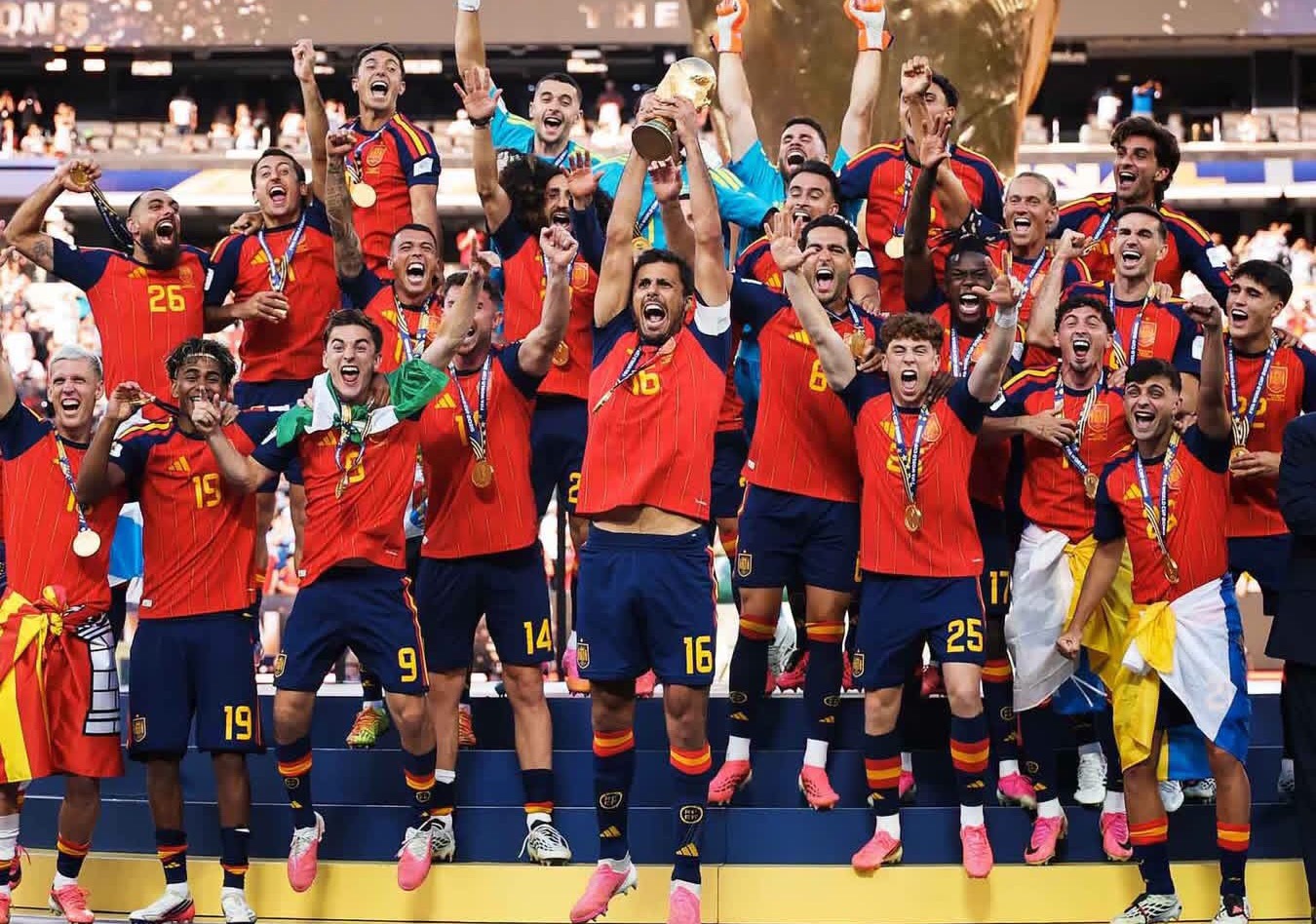
Ferran Torres etched his name into Spanish football folklore by scoring the goal that returned the FIFA World Cup to Spain, sealing a 1-0 extra-time victory over Argentina in a gripping final that showcased discipline, patience and defensive excellence before one decisive moment settled football’s biggest prize.
After 90 goalless minutes, Torres emerged as Spain’s unlikely hero, striking in the 106th minute to hand La Roja their second World Cup title and end Argentina’s reign as world champions. The victory came exactly 16 years after Spain’s maiden triumph in Johannesburg, where Andrés Iniesta also needed extra time to deliver the trophy.
Luis de la Fuente’s side entered the final as one of the tournament’s most impressive teams, and they largely controlled proceedings against the defending champions. Rodri dictated the tempo from midfield, Lamine Yamal repeatedly threatened Argentina’s defence, while Pau Cubarsí delivered another mature performance far beyond his years.
Argentina, meanwhile, struggled to impose themselves offensively. Lionel Scaloni’s men were forced into long periods without possession and relied heavily on goalkeeper Emiliano Martínez to keep the scores level. Despite Lionel Messi’s influence in deeper areas, Spain prevented the defending champions from creating meaningful scoring opportunities throughout normal time.
The contest swung decisively in Spain’s favour during stoppage time when Enzo Fernández was dismissed after receiving a second yellow card, leaving Argentina to play the additional 30 minutes with ten men. Spain patiently exploited the extra space before finally finding the breakthrough in extra time.
Torres’ winner sparked emotional scenes as Spain completed another chapter in one of the nation’s greatest football eras. The Barcelona forward, introduced from the bench, seized his moment by converting from inside the six-yard box after sustained Spanish pressure finally broke Argentina’s resistance.
Individual excellence accompanied Spain’s collective success. Rodri was named the tournament’s Golden Ball winner after orchestrating Spain’s midfield throughout the competition, Unai Simón collected the Golden Glove following another commanding display between the posts, while Cubarsí’s composed performances earned him the Best Young Player award.
Although Argentina fell short in their bid to defend the title, Lionel Messi still left his mark on history by becoming the first player ever to start three World Cup finals. However, Spain’s superior control, patience and persistence ultimately proved decisive as La Roja reclaimed football’s greatest prize.
Leave feedback about this