

Nathán Goldberg Crenier urges football leaders to pursue FIFA governance reforms, arguing the game’s credibility has been damaged by the FIFA president’s political alignment
A senior United States Soccer Federation executive has launched one of the strongest public criticisms yet of FIFA president Gianni Infantino, accusing him of compromising football’s independence through his close relationship with US President Donald Trump and calling on football leaders worldwide to push for structural reforms within world football’s governing body.
In an opinion article published by The Guardian, Nathán Goldberg Crenier, the elected vice-president of US Soccer, described Infantino’s relationship with Trump as a “Faustian bargain” that has entangled football in domestic and international politics while damaging FIFA’s credibility. Goldberg Crenier stressed that he was writing in a personal capacity and that the article did not necessarily represent the official position of US Soccer.
The article follows weeks of controversy surrounding Infantino’s public appearances alongside Trump during the 2026 FIFA World Cup, including White House meetings, a FIFA Council gathering at Trump Tower and the fallout from the disciplinary case involving United States forward Folarin Balogun. Trump publicly claimed he had urged Infantino to intervene after Balogun’s red card, while Infantino later confirmed the two spoke but insisted FIFA’s independent judicial bodies alone made the disciplinary decision.
Goldberg Crenier argued that the repeated public association between FIFA’s president and political leaders has undermined football’s longstanding claim of neutrality.
“Infantino’s Faustian bargain with Trump has stained football’s biggest stage,” he wrote, arguing that football should remain “inclusive, democratic and accessible to everyone.”
The US Soccer vice-president also criticised what he described as FIFA’s increasing centralisation of power under Infantino, warning that governance decisions have become overly dependent on the authority of one individual rather than robust institutional processes.
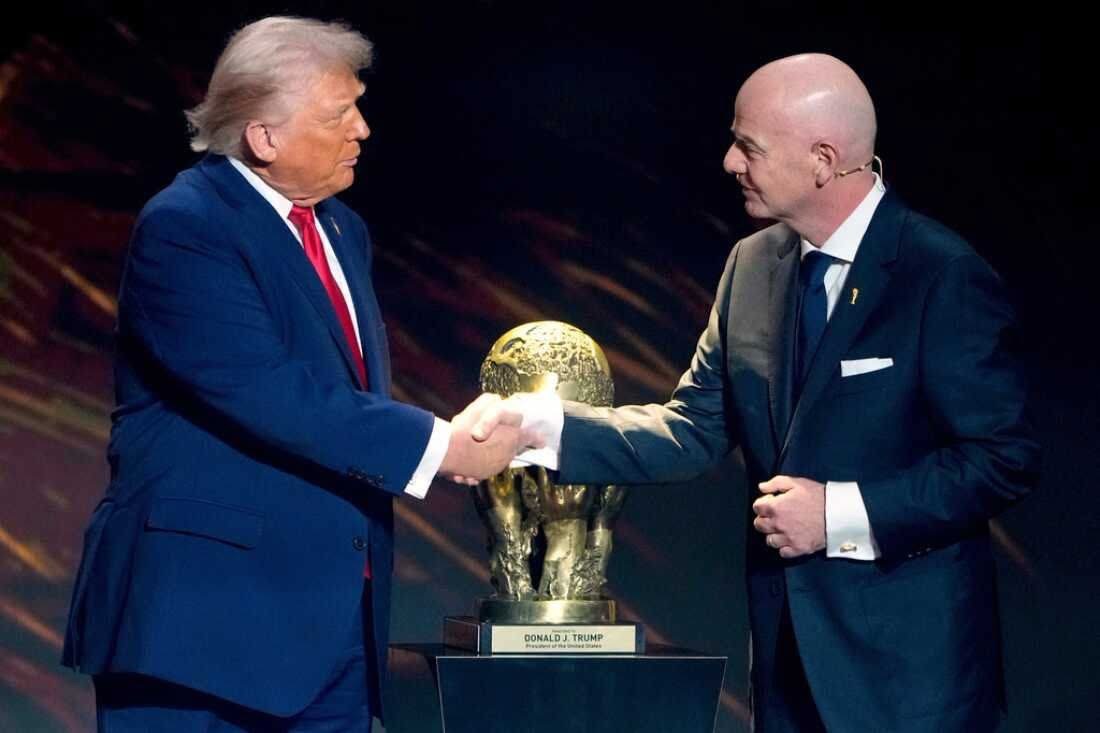
Among the examples cited were Infantino’s public praise of Trump, FIFA’s creation of a controversial “Peace Prize” awarded to the US president in late 2025, and the perception that the Balogun disciplinary controversy blurred the lines between politics and sporting governance. Goldberg Crenier further argued that geopolitical tensions involving Iran created uncertainty over the country’s participation in the 2026 World Cup, illustrating how political developments can increasingly affect football when governance lacks sufficient independence.
While acknowledging the commercial success of the expanded 2026 FIFA World Cup, Goldberg Crenier contended that financial growth should not come at the expense of the game’s integrity.
He called on football associations, confederations and FIFA stakeholders to pursue governance reforms that would decentralise decision-making, strengthen institutional checks and balances, and reduce the concentration of authority within the office of the FIFA president.
The intervention comes at a politically sensitive moment for FIFA as Infantino is widely expected to seek a third presidential term. Although no major challenger has formally declared a candidacy, recent reports indicate that several UEFA member associations have privately discussed the possibility of backing an alternative candidate while Infantino continues to enjoy significant support across CAF, the AFC and CONCACAF.
FIFA has consistently defended the independence of its governance and judicial processes. Following the Balogun controversy, Infantino stated that FIFA’s judicial bodies operate autonomously and that he respects their decisions regardless of his personal views.
Goldberg Crenier concluded by urging football’s leadership to reject what he characterised as an increasingly transactional vision for the sport, arguing that protecting football’s global, inclusive character requires stronger institutions rather than stronger personalities.
Editorial note: This report concerns an opinion article written by Nathán Goldberg Crenier. The views expressed are his own and, as stated in the article itself, do not necessarily reflect the official position of the United States Soccer Federation nor JerseyNumber12.com editorial position.
Leave feedback about this