

Politics, Power and Profit: How FIFA’s Most Controversial Tournament Left Football Facing a Crisis of Trust
From unprecedented disciplinary decisions and political interference to immigration disputes, commercial excess and growing calls for reform, the 2026 FIFA World Cup may be remembered as much for its controversies as Spain’s triumph on the pitch.
Spain’s 1-0 extra-time victory over Argentina brought the curtain down on a memorable FIFA World Cup, restoring La Roja to the summit of world football 16 years after their first triumph in South Africa. Ferran Torres’ decisive goal ended Argentina’s reign as champions, Rodri collected the Golden Ball, Unai Simón claimed the Golden Glove, and teenage defender Pau Cubarsí announced himself as football’s next great defensive talent.
Yet while Spain celebrated a second world title, another story was unfolding away from the pitch.
The 2026 FIFA World Cup leaves behind a legacy unlike any previous edition. Instead of discussion being dominated solely by tactical innovations, unforgettable goals and footballing brilliance, the tournament repeatedly found itself engulfed by questions about governance, politics, commercialisation and the independence of world football’s governing body.
By the final whistle, the tournament had become one of the most politically divisive and institutionally controversial World Cups in modern history. UEFA president Aleksander Čeferin boycotted the final, senior officials openly challenged FIFA president Gianni Infantino’s leadership, national federations questioned disciplinary consistency, immigration decisions affected match officials and delegations, while concerns over commercial priorities and proposed future expansion reignited debate about where football is heading.
A Tournament That Broke New Ground — For Better and Worse
The 2026 World Cup was historic before a ball had even been kicked.
Hosted jointly by the United States, Canada and Mexico, it became the first World Cup featuring 48 nations, expanding from the traditional 32-team format. FIFA hailed the expansion as a victory for global inclusion, giving more countries the opportunity to compete on football’s biggest stage.
Commercially, the tournament generated unprecedented revenues through sponsorships, hospitality packages, broadcast rights and ticket sales.
Yet almost every milestone seemed accompanied by controversy.
Critics questioned soaring ticket prices, extended commercial programming around matches, increasingly elaborate entertainment shows and FIFA’s growing emphasis on maximizing revenue streams. Human-rights organisations also raised concerns over immigration policies, security measures and the treatment of some participating delegations and supporters.
For many observers, the football itself often had to compete with headlines generated off the pitch.
The Balogun Decision That Changed Everything
No incident defined the governance debate more than FIFA’s handling of United States striker Folarin Balogun.
During the Round of 32 victory over Bosnia and Herzegovina, Balogun received a straight red card after a VAR review. Ordinarily, FIFA’s disciplinary regulations impose an automatic one-match suspension following a direct dismissal.
Instead, in one of the most controversial disciplinary decisions in World Cup history, FIFA announced that implementation of Balogun’s suspension would be deferred, allowing him to play in the United States’ Round of 16 match against Belgium while the case remained under review. FIFA cited Article 27 of its Disciplinary Code in explaining the procedural basis for the decision.
Although FIFA insisted its independent disciplinary bodies made the decision in accordance with its regulations, the timing immediately generated widespread criticism.
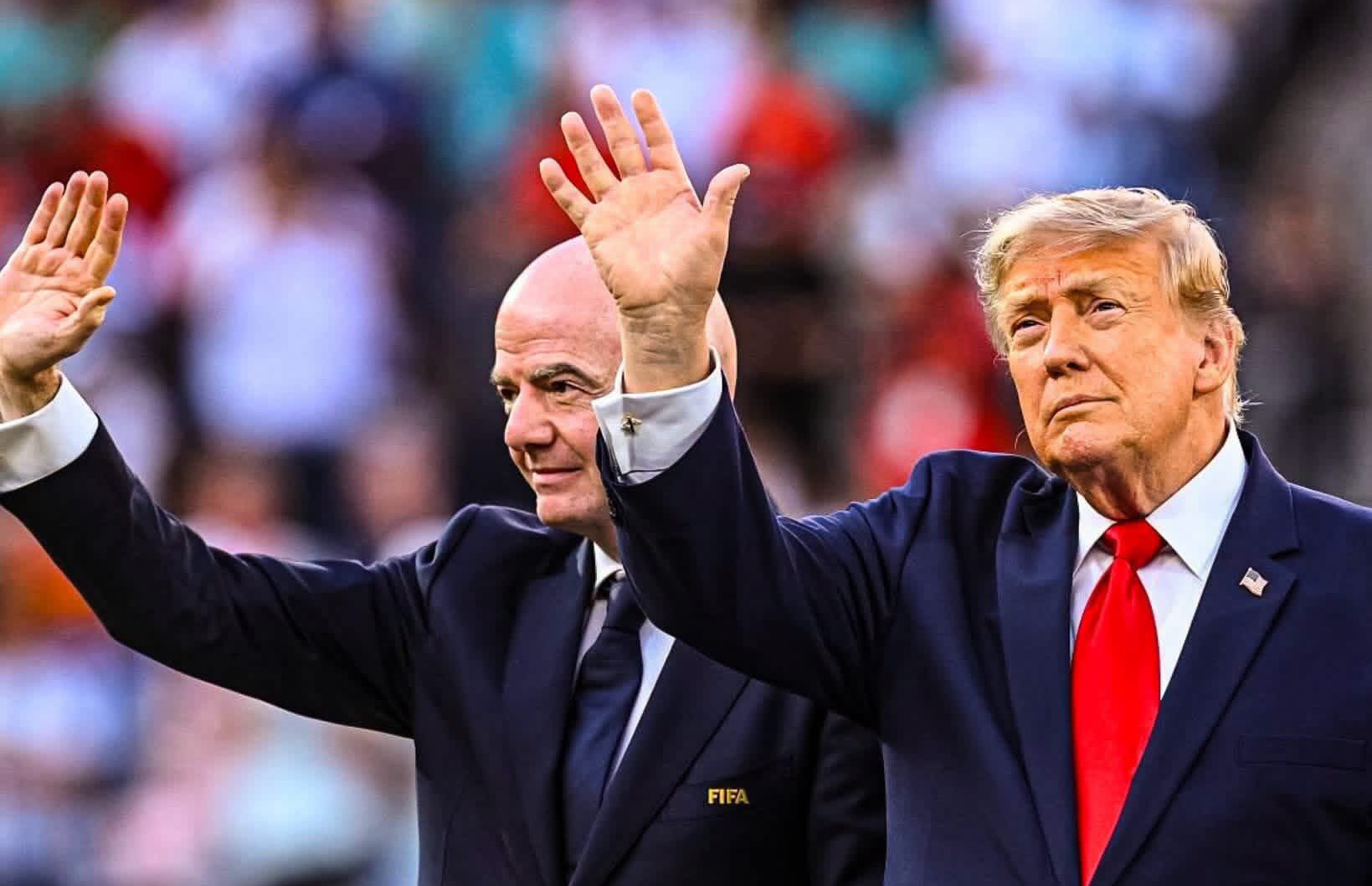
The controversy intensified after US President Donald Trump publicly stated he had contacted FIFA president Gianni Infantino regarding Balogun’s availability.
Infantino later acknowledged speaking with Trump but maintained the disciplinary process remained independent and that he had no authority over judicial decisions.
Whether or not political influence altered the outcome, perception quickly became reality. To critics, football’s long-standing insistence on sporting independence had suffered one of its greatest blows.
UEFA Draws a Line
The reaction from Europe was swift. UEFA issued one of the strongest statements in its modern relationship with FIFA, describing the Balogun decision as “incomprehensible” and warning that it undermined confidence in football’s disciplinary system.
The disagreement rapidly evolved from a single disciplinary dispute into an institutional confrontation.
By the tournament’s closing stages, UEFA president Aleksander Čeferin had chosen not to attend the World Cup final despite Spain—one of UEFA’s member associations—competing for the trophy.
Reuters reported that his boycott reflected broader frustrations extending beyond Balogun, including concerns about refereeing matters, tournament operations, governance and FIFA’s increasingly centralised decision-making under Infantino.
For many within European football, the issue was no longer merely about one player. It had become a debate about whether FIFA’s governance structure still possessed sufficient institutional safeguards against political influence.
The ‘Faustian Bargain’
Perhaps the strongest criticism came not from Europe, but from within American football itself.
In a remarkable opinion article published by The Guardian, Nathán Goldberg Crenier, vice-president of the United States Soccer Federation, accused Infantino of entering what he described as a “Faustian bargain” with Donald Trump.
Writing in a personal capacity rather than on behalf of US Soccer, Goldberg Crenier argued that football had become increasingly politicised through Infantino’s close public relationship with the US president.
He criticised repeated White House appearances, the optics surrounding the Balogun affair and what he viewed as FIFA’s growing willingness to align itself with political power in pursuit of institutional influence. More importantly, he argued that football needed structural reforms designed to decentralise power within FIFA rather than concentrating authority around its president.
His intervention transformed what had initially appeared to be isolated criticism into a broader governance debate stretching far beyond Europe.
Immigration, Politics and Commercialisation: The Controversies That Followed Football Across North America
While FIFA repeatedly promoted the slogan “Football Unites the World,” the 2026 World Cup also exposed how geopolitics and immigration policies could directly affect football’s biggest event.
Unlike previous tournaments staged in a single country, the expanded competition spread across the United States, Canada and Mexico. However, because the majority of knockout matches—including the final—were hosted in the United States, American immigration policies inevitably became part of the tournament narrative.
For the first time in modern World Cup history, visa approvals, border inspections and security screening became almost as prominent as team selections and tactical discussions.
The Omar Artan Story That Shocked World Football
No case better illustrated the intersection between football and immigration than that of Somali referee Omar Abdulkadir Artan.
After years of progressing through FIFA’s refereeing pathway, Artan earned what many considered the greatest honour of his career—selection as one of the match officials for the FIFA World Cup.
According to multiple reports, Artan travelled to the United States carrying FIFA accreditation, a valid visa and all the documentation required for the tournament. Yet upon arrival he was detained for extended questioning by US immigration authorities before ultimately being denied entry into the country. US Customs and Border Protection later confirmed that admissibility decisions are made under US immigration law following individual security assessments, while FIFA acknowledged that Artan would not participate in the tournament.
The incident immediately generated concern throughout international football.
Although the United States maintained that immigration decisions fall exclusively within its sovereign authority, critics questioned how a referee officially appointed by FIFA could be prevented from participating after completing FIFA’s own selection process.
UEFA president Aleksander Čeferin later cited the Artan affair as one of several reasons behind his deteriorating relationship with FIFA during the tournament. Reuters reported that UEFA regarded the situation as evidence that operational planning between FIFA and host governments had fallen short of the standards expected for football’s flagship competition.
Ironically, only days after missing the World Cup, UEFA appointed Artan to officiate the UEFA Super Cup—a move widely interpreted as a public demonstration of confidence in the Somali official.
Iran and the Politics Football Could Not Escape
The World Cup also unfolded against an exceptionally tense geopolitical backdrop.
Months before the tournament, Iranian football had already become entangled in diplomatic disputes after senior officials experienced visa-related difficulties entering the United States for World Cup events. FIFA publicly maintained that it was working with the host authorities to ensure participating teams could compete, while also insisting it remained politically neutral.
During the competition itself, further controversy emerged after Iranian football officials complained about restrictions affecting supporters and team operations.
Iran’s Football Federation publicly protested what it described as the revocation of ticket allocations intended for Iranian supporters, arguing that equal access should be guaranteed regardless of nationality. The federation urged FIFA to uphold its principles of neutrality and fairness while avoiding political discrimination. Several international media outlets reported the dispute, although FIFA did not publicly accept that its ticketing policies had targeted any specific nation.
Human-rights organisations also argued that broader geopolitical tensions involving Iran created additional challenges for the tournament, further complicating FIFA’s long-standing commitment to separating football from international politics.
Growing Questions Over Delegation Treatment
Artan’s case was not the only immigration-related controversy.
Throughout the tournament, several delegations reported unusually extensive security screening upon arrival in the United States. While host authorities insisted these procedures reflected routine border-security protocols applied under US law, critics argued that inconsistent treatment risked undermining FIFA’s message of equality among participating nations.
Media reports documented concerns involving officials connected with Iraq, Senegal and other delegations, although the precise circumstances varied considerably from case to case. In every instance, US authorities maintained that immigration decisions remained subject to domestic legislation rather than sporting considerations.
For FIFA, the challenge extended beyond legal explanations. Perception increasingly became part of the tournament story.
The Most Commercial World Cup Ever?
If immigration became one defining off-field issue, commercialisation became another. Never before had a FIFA World Cup generated such sustained debate over pricing and revenue generation.
Average ticket prices for the final reached unprecedented levels, while hospitality packages and resale values climbed into territory previously associated with the Super Bowl rather than football.
Critics argued that football’s biggest event was becoming progressively less accessible to ordinary supporters. The tournament also introduced entertainment elements that divided opinion.
The World Cup final featured an expanded halftime production that significantly exceeded football’s traditional 15-minute interval. UEFA officials privately expressed concern about operational consistency, while several former players questioned whether football risked borrowing too heavily from North American entertainment models. Reuters and multiple British media outlets reported that the extended halftime formed part of the broader disagreements between UEFA and FIFA during the competition.
Mandatory hydration breaks, enhanced commercial programming and expanded fan experiences further reflected FIFA’s effort to maximise commercial opportunities throughout the tournament. Supporters welcomed some innovations. Others feared football itself was gradually becoming secondary.
Expansion, Governance and the Road to 2030: Can FIFA Restore Trust Before Football’s Next Global Showcase?
If the controversies surrounding the 2026 FIFA World Cup exposed deep divisions within global football, the debate over the tournament’s future has already begun.
Barely weeks after the final, attention shifted from Spain’s triumph to an even bigger question: what should the FIFA World Cup become?
For many administrators, expanding football’s flagship competition represents progress. For many players, coaches and football traditionalists, it represents another step towards over-commercialisation. The discussion is no longer theoretical, it has already started.
The Push Towards a 64-Team World Cup
One of the most significant post-tournament developments came from CONMEBOL President Alejandro Domínguez, who publicly backed increasing the number of participating nations at the 2030 FIFA World Cup from 48 to 64 teams.
Domínguez argued that the centenary edition of the tournament should be “unique” and involve as many countries as possible. His proposal comes after FIFA had already expanded the competition from 32 to 48 teams for the 2026 edition, significantly increasing the number of matches played throughout the tournament. FIFA has confirmed that the proposal will be examined through its governance structures but has not adopted it as official policy.
Supporters believe further expansion would give smaller football nations unprecedented opportunities to compete on the world’s biggest stage. Critics see something different.
They argue that each expansion creates more broadcasting inventory, more sponsorship opportunities, more hospitality packages and ultimately more commercial revenue for FIFA.
Former players’ unions have also questioned whether continued expansion can be justified at a time when elite footballers already face increasingly congested calendars.
A Calendar Reaching Breaking Point
The debate over expansion cannot be separated from football’s growing workload crisis. The 2026 World Cup followed another demanding European club season, expanded continental competitions and the enlarged FIFA Club World Cup. Leading players have repeatedly warned that the calendar is becoming unsustainable.
Several managers, including Pep Guardiola, Carlo Ancelotti and Jürgen Klopp in recent years, have expressed concern that excessive scheduling increases injury risk while reducing the quality of elite competition.
Medical studies commissioned by players’ unions have similarly highlighted rising workloads across international football.
Against that backdrop, critics argue that adding even more World Cup matches risks prioritising commercial growth over player welfare.
Commercial Growth Versus Competitive Integrity
The expansion debate also raises another sensitive question. Does increasing the number of participating nations strengthen the World Cup, or dilute it? FIFA has consistently defended expansion as a way of making football more inclusive and representative of its global membership.
Indeed, the 2026 tournament produced memorable performances from emerging football nations, reinforcing FIFA’s argument that expanding access can create new opportunities and inspire football development across continents.
Yet critics counter that qualification should remain one of football’s greatest achievements. They fear that continuous expansion risks reducing the prestige historically associated with reaching the World Cup while creating more one-sided matches during the early stages of the competition. The debate remains unresolved.
A Crisis of Confidence
Perhaps the greatest challenge confronting FIFA is not commercial. It is institutional.
Throughout the tournament, controversies surrounding disciplinary decisions, immigration issues, governance disputes and political influence combined to create what many observers described as a growing crisis of confidence.
UEFA’s unprecedented public disagreements with FIFA illustrated that concerns were no longer confined to journalists or supporters. Senior football administrators themselves were openly questioning aspects of FIFA’s leadership and governance.
The Balogun disciplinary controversy, the Omar Artan immigration case and wider operational disputes became symbols of broader concerns about transparency, accountability and institutional independence.
For FIFA, rebuilding trust may ultimately prove more important than expanding tournaments.
FIFA Defends Its Record
FIFA has consistently rejected suggestions that politics influenced its sporting decisions.
Regarding Folarin Balogun’s suspension, FIFA maintained that the temporary suspension of the sanction was implemented through the organisation’s independent disciplinary mechanisms in accordance with its regulations, not through presidential intervention.
Similarly, FIFA has repeatedly stated that immigration matters remain the responsibility of sovereign governments and that it continued working closely with host authorities to facilitate tournament operations wherever possible.
On tournament expansion, FIFA argues that broadening participation strengthens football’s global development while providing opportunities for countries historically excluded from the competition.
The governing body also points to record television audiences, unprecedented global engagement and commercial success as evidence that the 2026 tournament represented another milestone in football’s worldwide growth.
The Road to Morocco, Portugal and Spain
Attention now turns towards the 2030 FIFA World Cup, which will be jointly hosted by Morocco, Portugal and Spain, with commemorative opening matches scheduled in Uruguay, Argentina and Paraguay to celebrate the centenary of the first World Cup.
It promises to be one of the most ambitious sporting events ever organised. It will also arrive under unprecedented scrutiny. The governance questions raised during 2026 are unlikely to disappear. Instead, they may become even louder.
National associations, confederations, players’ unions and supporters will increasingly expect FIFA to demonstrate that lessons have been learned from the controversies that overshadowed football’s greatest tournament.
Football’s Defining Moment
History will rightly remember Spain as worthy world champions. Rodri’s brilliance, Ferran Torres’ decisive extra-time goal and Luis de la Fuente’s remarkable side deserve their place among football’s great champions.
But history may also remember the 2026 World Cup for something far bigger than who lifted the trophy.
It was a tournament that forced football to confront uncomfortable questions about governance, transparency, commercial priorities and political influence.
Whether those questions ultimately become the catalyst for meaningful reform, or merely another chapter in football’s long-running struggle between sport, money and power, will shape not only the 2030 World Cup, but perhaps the future direction of the global game itself.
For FIFA, the challenge is now unmistakably clear. Winning back trust may prove even harder than staging the world’s biggest football tournament.
Leave feedback about this